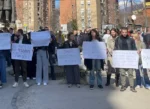
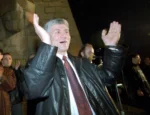
Kosovo’s Prime Minister Albin Kurti has commemorated the 1981 Kosovo protests, describing them as one of the key moments in Kosovo’s political history.
In a Facebook post marking the 45th anniversary of the demonstrations on March 11, 1981, Kurti recalled how students of the University of Prishtina launched a massive protest that opened a new political chapter for Albanians living under Yugoslavia.
According to Kurti, the demonstrations began as a broader movement led by students who had earlier protested on March 4 over poor conditions in the university cafeteria, but the protests soon evolved into clear political demands.
From Student Protest to Mass Movement
Kurti noted that on March 11, which also fell on a Wednesday like this year, thousands of people from across Kosovo joined the students’ call to protest. Many of the organizers and voices articulating the demands were activists linked to underground political organizations at the time.
The protests were united under the slogan “Kosova Republikë” (Kosovo Republic), often abbreviated as “KR.” This reflected the demand of Kosovo Albanians for Kosovo to become the seventh republic within the Yugoslav federation.
The demonstrations of March 11 were followed by mass protests on March 26 and April 1–2, 1981, events that collectively became known as the “Spring of ’81,” a period Kurti described as a season of political uprising and national awakening for Albanians under Yugoslavia.
Violent Suppression
Kurti also recalled that the demonstrations were violently suppressed by Yugoslav police, leading to thousands of arrests, arbitrary detentions, political trials, and long prison sentences.
Despite the repression, he said the 1981 protests redirected the political organization of Albanians in Yugoslavia, eventually culminating years later in the armed resistance of the Kosovo Liberation Army (KLA).
“On the 45th anniversary of the 1981 demonstrations, we remember with gratitude all the individuals and groups who gave life to that political movement and the generations that united in those historic protests,” Kurti wrote.