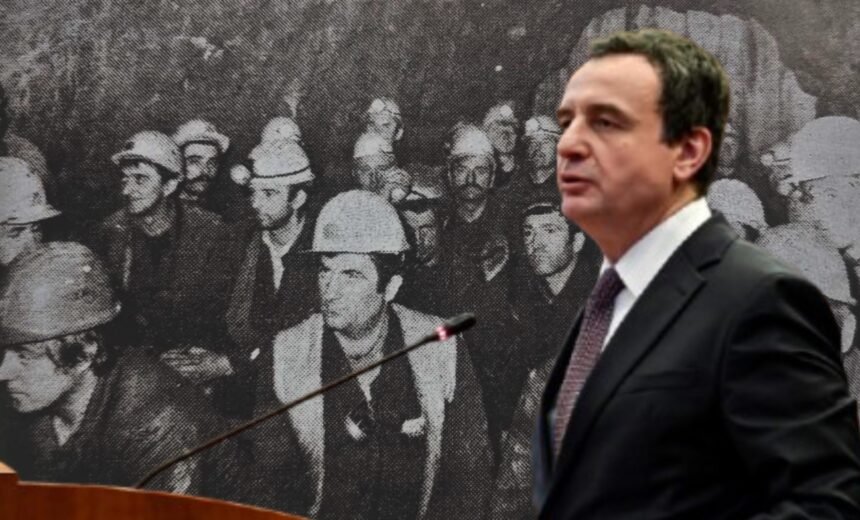
Kosovo Prime Minister Albin Kurti marked the 37th anniversary of the Trepça miners’ strike, highlighting it as a historic act of resistance that contributed to Kosovo’s state-building efforts.
Although the miners’ demands were not fully realized, Kurti emphasized that the strike at Stantërg represented the first major act of resistance that triggered the era leading to the collapse of Yugoslavia under Serbian leader Slobodan Milošević, culminating in Kosovo’s liberation in June 1999.
“Concerned about the political fate of Albanians in Yugoslavia and the violation of Kosovo’s status as an autonomous province and a constitutive element of the federation, the miners went on strike from February 20 to 28, insisting on ten demands, including that the Albanian issue in Yugoslavia be addressed at the United Nations,” Kurti stated.
He recalled that political activism by the miners was not new: on November 17, 1988, Trepça miners marched from Stantërg to Prishtina, demanding political recognition for the working class. Even earlier, on September 28, 1983, miners Xhavit Bajraktari and Shyqri Miftari had written slogans on the walls of the workers’ canteen declaring “Kosovo Republic” and “Trepça is ours”.
Kurti stressed that all generations will remember these struggles, as history forms the foundation of Kosovo’s political house: the Republic of Kosovo.
He added that the Kosovo Provincial Committee did not respond to the miners’ demands, instead using delegates and deceptive maneuvers to end the strike. On March 1, 1989, striking miners left Shafts 8 and 9, the mine was closed, and 15 miners were arrested and sentenced to 14 months in prison each. Three weeks later, on March 23, 1989, Serbia revoked Kosovo’s autonomy, paving the way for the installation of apartheid-like control in Kosovo.
“Even though the miners’ demands were not met, the strike at Stantërg was the first broad act of resistance that initiated the era of the dismantling of Yugoslavia under Milošević, ultimately leading to Kosovo’s liberation in June 1999,” Kurti concluded.