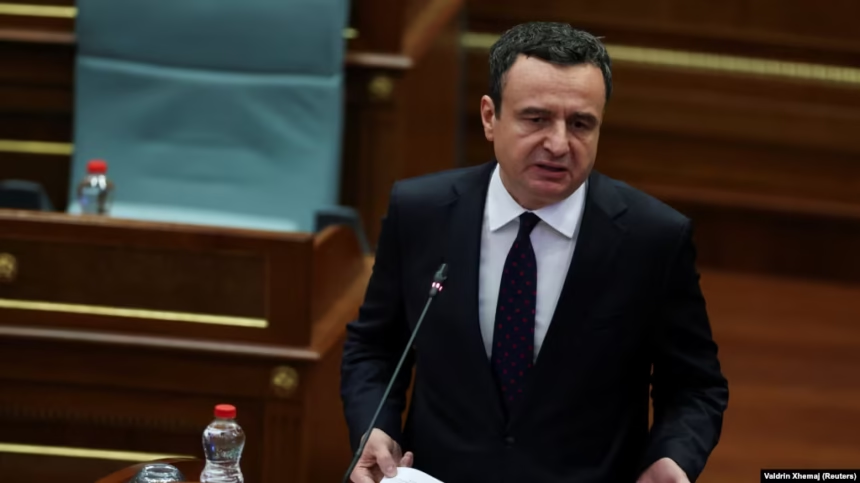
Acting Prime Minister Albin Kurti stated on Friday that Kosovo requires a renewed relationship between the government and opposition in order to pass crucial international agreements and elect a new president, thereby avoiding another political crisis.
Kurti’s party, Vetëvendosje, won the early parliamentary elections on December 28 decisively, securing 57 of 120 seats in the Assembly, and is expected to soon form its third four-year government.
However, the party lacks the 82-seat supermajority required to approve key legislation, including international agreements and the election of the president.
Speaking to journalists, Kurti said he had met with President Vjosa Osmani, who is seeking a second five-year term, but emphasized that the Assembly vote for a new president is only the “fourth step” in a sequence of procedures, following certification of election results, constitution of the new Assembly, and formation of the new government.
While Kurti expressed confidence in forming the government, he called on the opposition to cooperate on international agreements and the presidential vote. Two key international agreements awaiting Assembly approval include the European Union’s Reform and Growth Plan worth €882 million and three agreements with the World Bank’s International Development Association exceeding €120 million. Ratification of these agreements was delayed throughout 2025 due to the absence of new institutions.
“We need to see in the Assembly whether there is an atmosphere for a new government–opposition relationship,” Kurti said. “The people have given us overwhelming support, which carries great responsibility in forming the government. We will have no problem forming it, but for the two-thirds majority needed in the Assembly – from international agreements to electing the president – we need cooperation with the opposition.”
Failure to elect a new president before Osmani’s term ends in April could trigger early elections for the third time in approximately 12 months.
The establishment of new institutions after the December elections was delayed after the Central Election Commission was required to recount votes nationwide due to allegations of vote manipulation. The commission is expected to finalize the recount by Friday afternoon, after which results will be certified and the new Assembly constituted.
There are concerns that the constitution of the Assembly could face further blockages following a Constitutional Court decision, which ruled that Nenad Rashiq, deputy speaker representing the Serb minority after the February elections, was elected in violation of the Constitution.
The Serb List, Kosovo’s largest Serb party backed by Belgrade, won nine of ten reserved seats for the Serb community in the December elections. Rashiq won the remaining seat for the Freedom, Justice and Survival Party.
Asked about the court ruling, Kurti said he could not comment without reviewing the full judgment, which is expected to be published soon.
“I expect that next week we will have the full judgment, and only then will we be able to provide a clear and precise response. What I hope is that the Constitutional Court’s January–February 2026 decision will not contradict previous rulings from 2025, particularly from October, as it concerns the same issue,” he said.
2025 was effectively a lost legislative year due to the inability of political parties to establish new institutions.