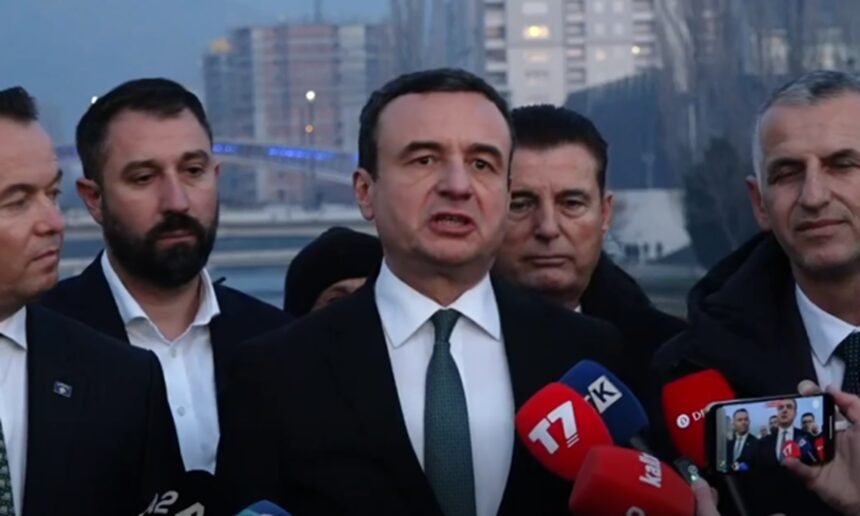
Kosovo’s Prime Minister, Albin Kurti, today commemorated the 20th anniversary of the death of Dr. Ibrahim Rugova, recognizing his historic role in state-building, democratization, and internationalizing Kosovo’s cause.
In his commemorative message, Kurti emphasized that the period of political pluralism and peaceful resistance is inseparably linked to Rugova, who led the Democratic League of Kosovo (LDK) from its founding in 1989 until his death on January 21, 2006. Kurti highlighted that Rugova’s contributions were supported by a broad circle of collaborators and activists who, during the 1990s, kept institutions and hope for freedom alive.
Kurti recalled that Rugova was elected President of the Republic of Kosovo in 1992, under harsh conditions imposed by the repressive Serbian regime, and managed to represent Kosovo internationally, meeting world leaders including U.S. President Bill Clinton. Kurti praised Rugova’s political wisdom and persistent commitment to peaceful resistance as key factors that oriented Kosovo towards the West.
Full post by Albin Kurti:
On the 20th anniversary of Dr. Ibrahim Rugova’s death
Today, two decades after his passing, we remember Dr. Ibrahim Rugova, the first President of Kosovo, distinguished political leader, engaged intellectual, and prominent scholar of literature.
In Kosovo’s history of state-building, the period of political pluralism, democratization, and internationalization of the country’s cause is inseparably connected to Ibrahim Rugova.
He was the first and longest-serving leader of the Democratic League of Kosovo (LDK), from its founding on December 23, 1989, until his death on January 21, 2006. His political role and contributions were articulated together with a generation of professionals who, especially during the 1990s, actively engaged in public and political life through LDK and stood by President Rugova.
During a time when Serbia had imposed an apartheid-like regime in Kosovo, Ibrahim Rugova assumed leadership of a politically and legally unique state, being elected President on May 24, 1992, of the Republic of Kosovo proclaimed by its delegates on September 7, 1990.
At a time when few recognized Kosovo as a Republic except Albania, Rugova established himself internationally, meeting world leaders, including U.S. President Bill Clinton.
His political wisdom and commitment to peaceful resistance opened doors for Kosovo in many forums and discussion tables. Rugova’s contributions were crucial in orienting Kosovo clearly towards the West and in properly internationalizing its cause, especially in the first years of the last decade of the 20th century.
He was the first President of the Republic of Kosovo, our first republic established for resistance, and also the first President of Kosovo after its liberation. On January 21, 2006, Rugova passed away while still in office. The presidency itself is marked by his long and distinguished tenure.
Born in Cerrcë, Istog, on December 2, 1944, during the final months of World War II, Rugova never knew his father, who disappeared during the turbulent post-war period. He studied Albanian language and literature at the University of Prishtina, ultimately earning a PhD in 1984, and worked as a literary researcher, publishing numerous studies and books. At the age of 45, he entered politics while maintaining his dedication to language and the written word.
Rugova’s political legacy is omnipresent across Kosovo’s political institutions—from LDK to the Assembly and Presidency—and among his collaborators and political successors. Dr. Ibrahim Rugova holds a unique place in Kosovo’s political and cultural history.