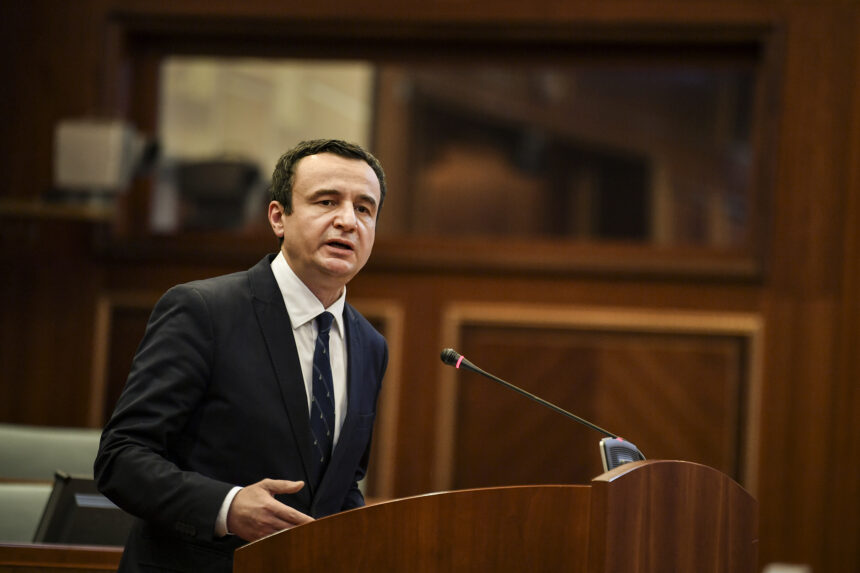
Prime Minister Albin Kurti has announced that political discussions will intensify in the coming days in an effort to reach a solution regarding the election of Kosovo’s next president. The statement came after his meetings with opposition leaders Bedri Hamza of the Democratic Party of Kosovo and Lumir Abdixhiku of the Democratic League of Kosovo.
With less than two weeks remaining before the constitutional deadline, Kurti acknowledged that securing the required votes will be difficult. He emphasized that the ruling party currently holds 66 votes in parliament, which is far short of the 80 votes needed in the first two rounds of the presidential election.
Kurti also clarified that the current president, Vjosa Osmani, who is seeking another mandate, is not his party’s candidate for the position.
Efforts to Avoid New Elections
The prime minister stressed that the key to resolving the issue lies with the three largest political parties — Vetëvendosje, PDK, and LDK — and said efforts are underway to prevent the country from heading to new elections.
“We will intensify discussions in order to find a solution on the issue of the president,” Kurti said, noting that many political actors believe Kosovo should avoid another election cycle after several rounds of elections in recent years.
He added that while there is willingness among parties to cooperate, there is no strong appetite for new elections, which he believes increases the chances of reaching an agreement.
Parliamentary Numbers Remain a Challenge
Kurti pointed out that even a potential cooperation between Vetëvendosje and LDK would not guarantee enough votes to resolve the issue and avoid elections. According to him, the political arithmetic in parliament must be addressed with maximum seriousness.
Despite the challenges, Kurti said the constructive atmosphere during meetings with opposition leaders makes him optimistic that a compromise can be reached within the limited time remaining.
Constitutional Requirements
Under Kosovo’s Constitution, a presidential candidate must first secure at least 30 signatures from MPs to enter the race. In the first and second rounds of voting, at least 80 of the 120 MPs must be present and vote, while in the third round, a simple majority of 61 votes is sufficient to elect the president.