In a quiet plea deal, the Balkan branch of Radio Free Europe revealed that three Serbian citizens were sentenced in December 2025 for placing pig heads in front of nine mosques in the Paris region in September 2025. The High Court of Smederevo, located 50 kilometers east of Belgrade, convicted them of espionage and racial discrimination.
The Serbian court also ruled against them for a May 2025 incident in which they threw green paint on the Shoah Memorial and three Parisian synagogues. French authorities later attributed both incidents to Russian intelligence structures, which reportedly provided orders and financial resources.
All three men, originating from the small town of Velika Plana, were recruited by a man known as “Hunter,” identified as Aleksandar Savic, and sent to France for a few thousand euros. They received sentences ranging from six to eighteen months under house arrest with electronic monitoring. Meanwhile, investigations continue for eight other individuals connected to the operations.
The group also carried out smaller, less visible acts of destabilization, including posting 600–700 stickers commemorating the Armenian genocide near the Arc de Triomphe in April 2025 and placing plastic skeletons in front of the Brandenburg Gate in Berlin in July 2025. According to Serbian authorities, the goal of these actions was political destabilization and incitement of religious and ethnic hatred in France and Germany.
Training Camps and Recruitment
In 2025, Serbia became the primary hub for Russian destabilization efforts in Europe, including the training of over 150 Moldovan and Romanian recruits near the Serbia–Bosnia border, preparing for the Moldovan legislative elections in September. Two Serbian nationals were also arrested, but the Russian organizer of the camp remains at large.
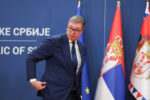
Experts note that Serbia’s role is strategic: the country is prorussian, does not require visas for Russian citizens, and has strong ties between President Aleksandar Vučić and Vladimir Putin, making it an ideal base for hybrid operations. Previous operations, such as the “Red Hands” incident in Paris in 2024, relied on Bulgarian nationals in a similar manner.
Media and Political Response
While international outlets such as RFE and BIRN have widely covered these Russian-backed operations, state-influenced Serbian media have largely ignored the events, reflecting the pro-Russian stance of the government. Analysts argue that Serbia has taken minimal steps to halt these operations, despite quick action in the Paris pig-head case, due to strong French pressure and bilateral relations, including the 2024 sale of twelve Rafale jets to Serbia by France.
Predrag Petrovic of the Belgrade Centre for Security Policy emphasized: “The Serbian authorities acted only because of irrefutable French evidence. On the broader issue, no significant measures have been taken to stop these operations.”
The incidents highlight the growing risk of hybrid warfare in Europe and the use of small, often untrained operatives for influence campaigns across the continent.