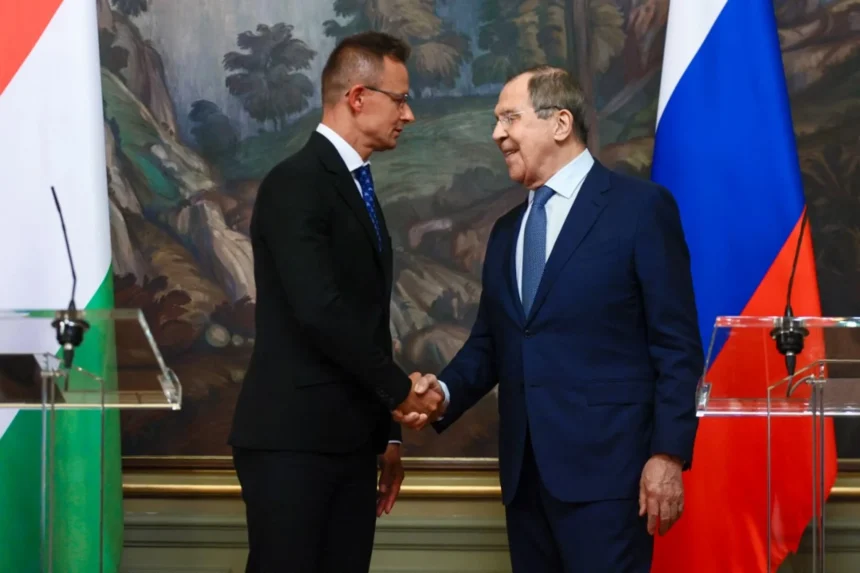
A leaked audio recording of a conversation between Péter Szijjártó and Sergey Lavrov has triggered political controversy ahead of Hungary’s upcoming parliamentary elections.
The 94-second recording, published by the Warsaw-based investigative outlet Vsquare.org, is reported to capture a phone call from August 2024. In the audio, Lavrov is heard requesting Szijjártó’s assistance in removing Gulbahor Ismailova—the sister of Russian oligarch Alisher Usmanov—from the European Union’s sanctions list.
“I’m calling at Alisher’s request… he asked me to remind you that you were doing something regarding his sister,” Lavrov says in the recording.
According to the clip, Szijjártó responds that Hungary, together with Slovakia, would submit a proposal to the European Union to remove her from the sanctions list.
The leaked call surfaces amid growing scrutiny of Hungary’s diplomatic ties with Moscow. It follows a report by The Washington Post alleging that Szijjártó shared sensitive information with Russian officials during meetings of the EU Foreign Affairs Council in Brussels.
The controversy comes at a sensitive time, as Hungary prepares for parliamentary elections scheduled for April 12. Issues surrounding foreign influence and the government’s close relationship with Russia have become central topics in the campaign.
Under EU rules, sanctions must be renewed unanimously every six months. Ismailova, along with other Russian figures, was ultimately removed from the sanctions list in March 2025.
The EU significantly downgraded political relations with Russia following the Russian invasion of Ukraine and has since urged member states to reduce dependence on Russian energy. However, Hungary and Slovakia have maintained regular high-level contacts with Russian officials and continue to import substantial volumes of Russian energy.
Szijjártó dismissed the controversy, arguing that communication with Russian counterparts before and after diplomatic meetings is standard practice. He also accused foreign intelligence services, with the involvement of Hungarian journalists, of intercepting his phone calls.
“It has long been known that foreign intelligence services… have been monitoring my conversations. Today they made another ‘great discovery’: that I say the same things publicly as I do privately. Good job,” he stated.
He added that Hungary has consistently opposed sanctions affecting critical energy security interests and would continue to take the same approach in the future.