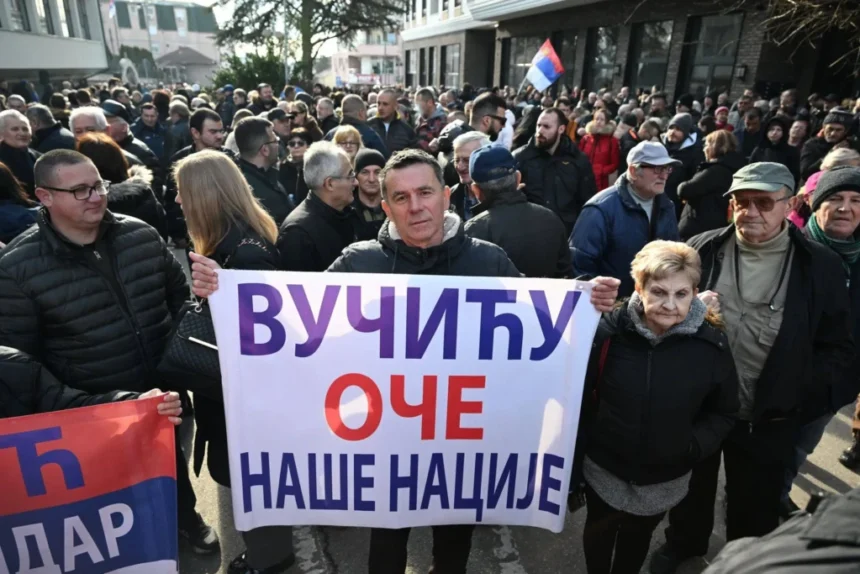
The upcoming local elections in ten Serbian municipalities are shaping up as a key showdown between the ruling parties and student-led lists, often supported or partnered with opposition parties.
The campaign has already seen multiple challenges to candidate lists, intense use of public officials for campaigning, threats to opposition candidates, fake lists, mergers and splits of lists, and even the appearance of “commissioners” using code names. One precedent involved a 2023 court ruling in Mionica, where a member of the local election commission representing the SNS (ruling party) was penalized for falsifying voting results.
This flurry of activity comes ahead of the March 29 elections in Bor, Aranđelovac, Bajina Bašta, Kladovo, Knjaževac, Kula, Lučani, Majdanpek, Smederevska Palanka, and Sevojno (a city municipality of Užice). These areas, mostly small, are traditionally pro-government, yet the elections are seen as a test of declining ruling party support.
Student-Driven Opposition Lists
In most municipalities, the decisive contest is expected to be between the ruling party lists and student-led opposition lists, sometimes in coalition with local opposition parties. For example:
- In Aranđelovac, the list “Students for Aranđelovac – Youth Wins” is supported by nine opposition parties.
- In Bajina Bašta, “United for Bajina Bašta” combines local students and opposition actors.
- In Bor, “Bor, Our Responsibility” includes students, non-partisan citizens, and opposition party members.
- In Sevojno, the “United – Sevojno” list, formed by students and citizens with full opposition support, secured official registration on its third attempt.
Fake Lists and Electoral Manipulation
The elections have seen a surge in fake or “phantom” lists. Election monitors (CRTA) identified 12 such lists and suspect four more out of a total of 43 registered. These lists often mimic the names, colors, and visual branding of genuine student or opposition groups to confuse voters. Examples include “Mladi za Kulu” (Young for Kula) designed to mimic “Mladi Kula” students’ list, and “Zeleni front za studente – Dragačevo,” which falsely implies support from the local Green-Left Front.
In Smederevska Palanka, student-opposition coordination faltered, leading to two separate lists arising from internal disputes: “Mladi za Palanku – Alone Against All” and “GG ‘Heal the System – Let Palanka Recover’.” Several other lists also appear fake or confusing, such as “United for Palanka” and “Narodna Lista – Slobodan Milojković, Professor.”
Minority Lists
Even municipalities with very few minority residents saw minority lists registered. For instance, Aranđelovac (population 41,297) has two minority lists – Bosniak-Montenegrin and Russian – despite only four residents identifying as Bosniak, 64 as Montenegrin, and 63 as Russian in the 2022 census.
New Parties and Political Dynamics
The Serbian Liberal Party (SLS), a relatively new and previously little-known party, could appear on all ten ballots, demonstrating the fluidity of local political dynamics. Founded by Dr. Dejan Žujović in April 2025, the party gained attention for helping form pro-government coalitions in Belgrade municipalities Stari Grad and Zvezdara after the June 2024 elections.
Overall, the elections in these ten municipalities reflect broader trends of student-opposition alliances, ruling party maneuvers, and the strategic use of fake lists to influence voter perception.