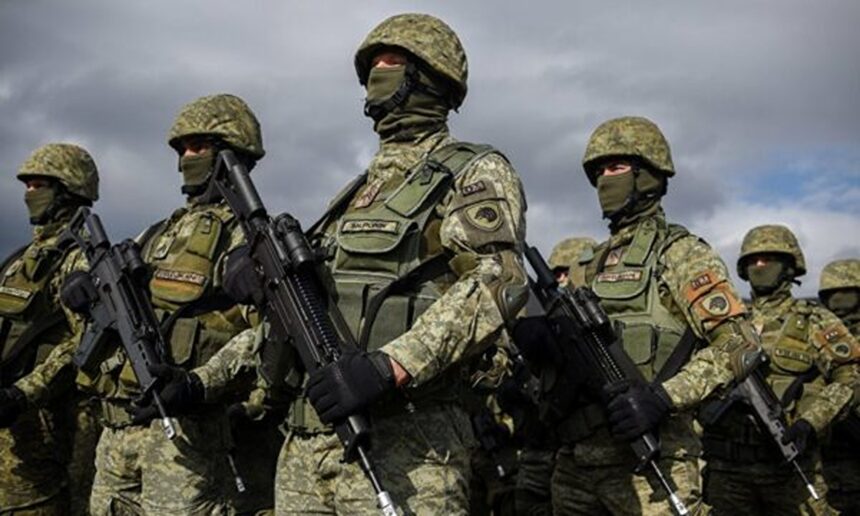
Young people in Kosovo will not be subject to mandatory military service, as the initiative has now been officially abandoned.
The Ministry of Defence of Kosovo has decided to replace the concept of compulsory service with a “total defense” model. Under this approach, citizens — regardless of profession — may perform voluntary service instead.
According to the Ministry in a statement to Tëvë1, the model is easier to manage logistically and aligns with practices applied by many NATO member states.
The core principle of this system is that defense is not treated solely as the responsibility of the armed forces, but as a comprehensive commitment of the state and society — ensuring that every citizen understands their role and responsibilities in case of emergency or crisis.
Retired Colonel Hysen Gecaj welcomed the ministry’s plan. He emphasized that the defense system does not rely exclusively on the Kosovo Security Force (FSK), but also involves other institutions such as the Intelligence Agency, the Police of Kosovo, and emergency services, which would all have defined roles in wartime scenarios.
Gecaj also suggested alternative models that could replace mandatory service without placing a heavy financial burden on the state. One proposal includes introducing defense education in schools — combining theoretical instruction with several weeks of practical training in FSK barracks — as a more cost-effective solution.
Previously, during his first mandate, Prime Minister Albin Kurti had stated that compulsory military service would be implemented “not to dominate, but to defend the country.” However, the government has now formally shifted its approach toward a voluntary and society-wide defense model.