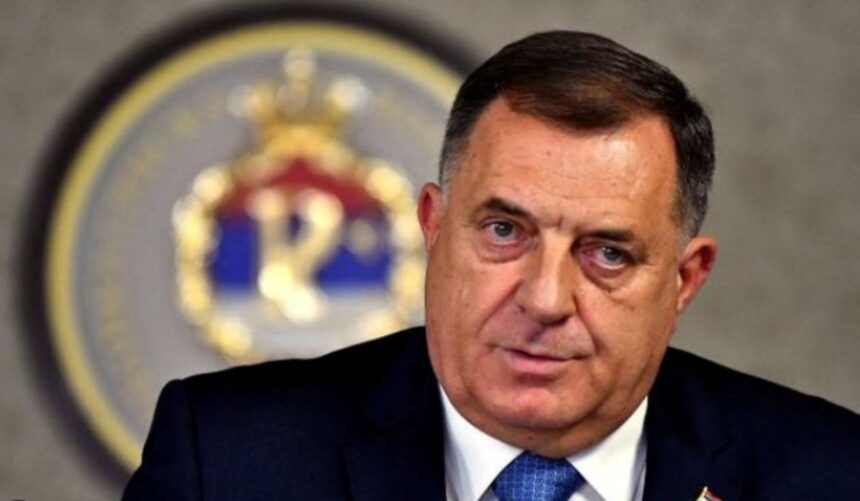
Bosnian Serb leader Milorad Dodik has continued to promote pro-Russian narratives despite the recent lifting of U.S. sanctions against him, according to an analysis by Radio Free Europe/Radio Liberty.
The report highlights that in the past five months, Dodik—leader of the ruling party in Republika Srpska—has frequently appeared in Russian state-affiliated media outlets such as RIA Novosti and Russia 24, where he has consistently praised Russia and criticized Western countries.
In his public statements, Dodik has described Russia as “a new civilization” while accusing the European Union of destabilizing the Balkans, with particular criticism directed at Germany.
He has also announced plans to visit Russia on May 9, marking Victory Day, where he expects to meet with Russian President Vladimir Putin and Foreign Minister Sergey Lavrov.
During interviews with Russian media, Dodik has voiced support for Russia’s invasion of Ukraine and claimed—without evidence—that Western countries, led by the EU, are working to dismantle Russia. He has further argued that closer cooperation with Moscow is essential, even suggesting that such ties could “save Europe from collapse.”
Dodik has also reiterated his opposition to Bosnia and Herzegovina joining NATO, stating that Republika Srpska rejects such a move and instead favors strengthening energy ties with Russia, including plans to connect to Serbia’s gas network to secure Russian supplies.
Despite his recent visit to the United States following the removal of sanctions, Dodik has continued to describe relations with Russia as “strategic.” Similar remarks were made during earlier engagements abroad, including meetings with Russian officials in Israel.
Meanwhile, officials within the European Commission, speaking informally, have downplayed the significance of Dodik’s statements in Russian media.
Political analyst Tanja Topić suggests that Dodik is pursuing a strategy of balancing between global powers, attempting to maintain ties with both Washington and Moscow.
“He will try not to jeopardize the goodwill currently shown by the United States, but will continue to balance and play on two fronts,” Topić said.
Dodik’s approach mirrors that of Aleksandar Vučić, reflecting a broader regional pattern of navigating between competing geopolitical influences.