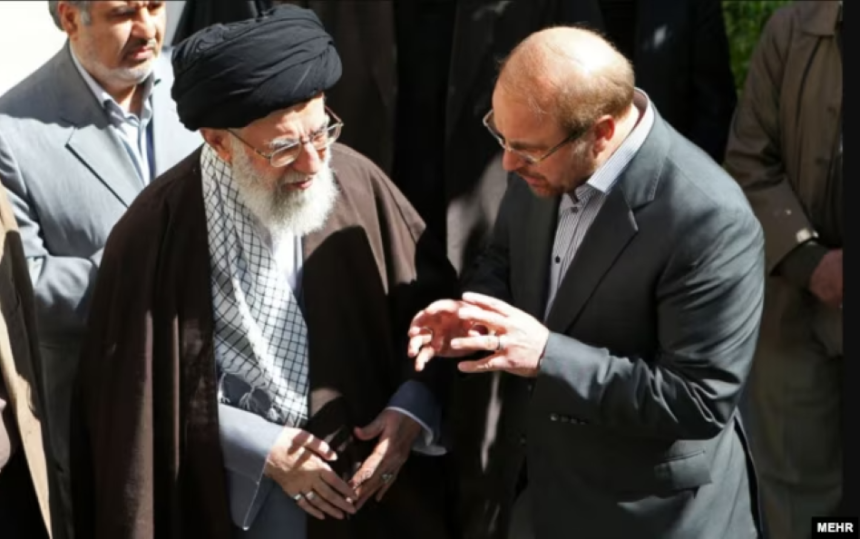
Mohammad Baqer Qalibaf, the conservative Speaker of the Iranian Parliament, has gained attention as a potentially influential figure in Iran’s political landscape following the death of Supreme Leader Ali Khamenei. Reports suggest that the U.S. administration under President Donald Trump may be quietly exploring Qalibaf as a possible interlocutor for negotiations or even as a future Iranian leader.
While Khamenei’s son has been mentioned as a successor, he has not been seen publicly since his father’s death and is reportedly injured in a recent U.S.-Israel airstrike. Qalibaf, 64, has categorically denied any negotiations with the U.S., describing such reports on social media platform X as “fake news” designed to manipulate oil and financial markets.
A former IRGC commander and long-time conservative politician, Qalibaf has built deep ties with Iran’s highest leadership and the Islamic Revolutionary Guard Corps (IRGC) over decades. His career has included roles as Air Force commander, Tehran police chief, and mayor of Tehran, often marked by allegations of brutality and corruption.
Qalibaf became Speaker of Parliament in 2020, overseeing legislation that advanced Iran’s nuclear program and consolidating his influence at the intersection of political, security, and clerical power. Analysts note that his closeness to Mojtaba Khamenei, Ali Khamenei’s son, has further strengthened his political leverage.
The recent deaths of top Iranian leaders, including the head of the IRGC, the Defense Minister, and the Armed Forces Chief of Staff, have created a vacuum at the top of the Iranian power structure. In this environment, Qalibaf has emerged as a key figure linking political authority, security institutions, and clerical leadership.
Hossein Razzaq, a political analyst, observes that Qalibaf has long been “an approved part of the Supreme Leader’s circle,” and with the elimination of other senior figures, “the role he now plays for the system has become significantly more important.”
As uncertainty surrounds Iran’s leadership and its relations with the U.S., Qalibaf’s position could make him a central figure in shaping the country’s domestic and foreign policy trajectory.