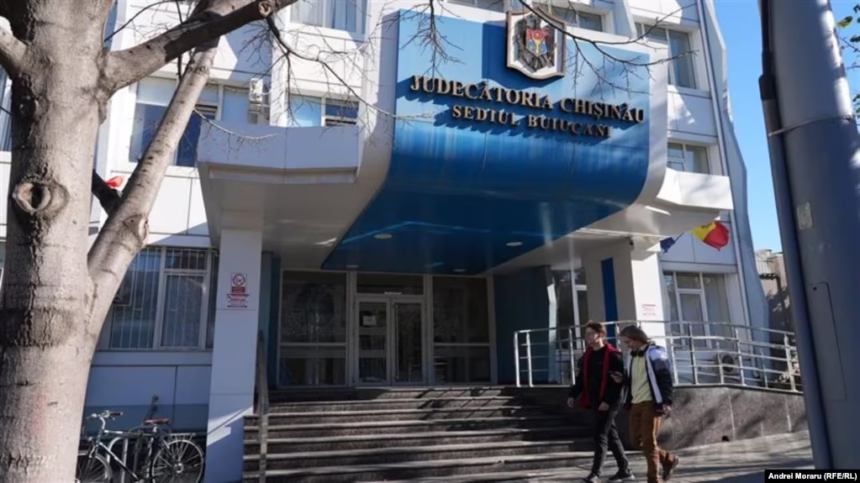
A court in Chișinău has sentenced three individuals for participation in an organized criminal group that, in 2024, prepared mass violent unrest in Moldova and conducted military-style trainings in Bosnia and Herzegovina and Serbia.
According to the indictment, the trainings were organized and led by Russian nationals in cooperation with Moldovan citizens, with the stated goal of instigating unrest in Moldova ahead of the 2024 presidential elections and the referendum on European Union membership.
Reports of “Russian camps” in Bosnia and Herzegovina first emerged in October 2024, when Moldovan security agencies announced they had identified more than 100 young individuals suspected of receiving training in Russia, Bosnia and Herzegovina, and Serbia to destabilize Moldova.
On February 6, the Chișinău court sentenced Aliona Gotcon and Ludmila Costencon to four years and one month in prison, while Vladimir Harcevnicov received a sentence of five years and four months.
The ruling was delivered at the first-instance court, and the defendants were not present for the announcement. The court issued arrest warrants to ensure that the sentences are enforced, while the verdict may still be appealed.
Coordinated Activities Linked to Russia
The court’s decision states that the defendants acted as part of a stable criminal structure coordinated from Russia, with clearly defined roles. Their activities reportedly included:
- Recruiting new members,
- Providing logistical support,
- Supplying equipment, and
- Conducting trainings for violent and destabilizing actions.
A significant part of the court ruling focuses on trainings held outside Moldova, primarily in Bosnia and Herzegovina and Serbia.
The court notes that the defendants traveled multiple times to Bosnia and Herzegovina, including the Glamoć area, where they took part in theoretical and practical exercises. The trainings reportedly covered:
- Advanced drone operation and integration with command centers,
- Aerial reconnaissance for strike groups,
- Simulated deployment of explosive devices via drones,
- Tactics to incite panic and chaos,
- Methods to breach police cordons,
- Diversion and sabotage operations, and
- Preparation of incendiary and explosive devices.
The court concluded that these activities were directly linked to plans for violent unrest in Moldova.
Serbia is mentioned in the court documents both as a training location and as a transit point for the defendants en route to Bosnia and Herzegovina.
Evidence Collected
Investigators discovered material evidence indicating the defendants’ presence in Serbia and Bosnia and Herzegovina, including:
- Local currency notes,
- SIM cards,
- Telecommunications equipment, and
- Digital recordings documenting their activities in the training camps.
During searches, authorities also seized drone parts, VR goggles, remote controls, batteries, secure document storage devices, and other digital materials, which the court found corroborated the training and operational plans.
Digital evidence included photos and videos from the camps, as well as instructions for drone use and preparation of incendiary and explosive devices.
Despite the defendants claiming ignorance of the criminal nature of their activities and describing their foreign travels as personal or professional engagements, the court rejected these defenses, citing clear evidence of coordination and intent.
Further Investigations and Arrests
During the trial, Moldovan prosecutors filed additional indictments against other individuals linked to the trainings aimed at fomenting unrest.
In Serbia, authorities arrested two individuals on September 26, 2025, suspected of organizing tactical military-style training for Moldovan and Romanian nationals to incite unrest in Moldova. These arrests followed public warnings from Chișinău about the existence of training camps in Serbia, allegedly organized by Russian intelligence services.
In early December 2025, Moldovan authorities conducted approximately 50 raids across the country, uncovering evidence that the organized group, previously trained in Serbia, had planned to spark violent unrest in Moldova.