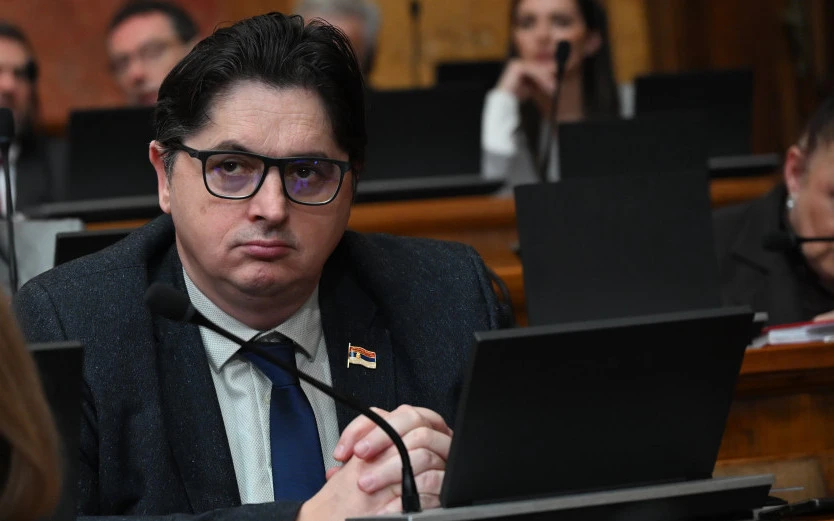
The adoption of a controversial set of judicial laws proposed by ruling Serbian Progressive Party (SNS) MP Uglješa Mrdić has triggered sharp reactions from Brussels, raising serious concerns about the state of judicial independence in Serbia and the credibility of its European integration path.
Although presented by the authorities as measures for “internal use,” the so-called “Mrdić laws” risk causing significant damage to Serbia’s relations with the European Union. Immediately after the laws were passed by the ruling coalition in parliament, the European Commission issued a clear warning: Serbia has taken a step backward on its EU path.
A Judicial Reform Without Transparency
The adopted amendments cover five key laws governing courts, prosecutors, judicial councils, and the fight against high-tech crime. Mrdić claims the changes will make the judiciary more efficient, arguing that courts and prosecutors must be staffed by individuals “loyal to the Serbian state.”
However, legal experts, opposition figures, and independent institutions warn that the real aim is to strengthen political control over the judiciary, undermining prosecutorial independence and opening the door to selective justice.
Critics stress that the laws were adopted without public debate, without consultations with judicial bodies, and without coordination with EU institutions, directly contradicting European standards and Serbia’s own reform commitments.
Brussels: A Serious Step Backward
EU Enlargement Commissioner Marta Kos described the parliamentary vote as a “serious step backward”, warning that Serbia risks isolating itself at a moment when Montenegro and Albania are advancing rapidly toward EU membership.
“This is not the direction we want to see,” Kos wrote, urging Serbian authorities to urgently revise the adopted laws and align them with European standards.
She emphasized that the amendments were rushed and adopted in a non-transparent manner, which directly threatens the independence of the judiciary.
Cases Involving Senior Officials at Risk
A particularly alarming aspect, according to experts, is that the changes could directly affect ongoing high-profile corruption and abuse-of-power cases, including “Generalštab” and “Canopy – Corruption”, in which current and former ministers Nikola Selaković and Goran Vesić are mentioned.
Legal analysts warn that weakening prosecutorial autonomy at this moment raises legitimate suspicions of political interference aimed at shielding senior figures within the Vučić regime.
Vučić’s Balancing Act
President Aleksandar Vučić now has seven days to decide whether to sign the laws. While insisting that the legislation is constitutional, Vučić admitted that the absence of public debate and EU consultations was a serious mistake.
Despite this acknowledgment, his statements suggest a familiar pattern: deflecting responsibility while preserving full political control over key institutions.
The Serbian Bar Association, judicial councils, and civil society organizations have openly urged Vučić not to sign the laws, warning that they endanger constitutional guarantees of judicial independence and violate standards set by the Venice Commission.
Growing Domestic Resistance
Opposition has also come from law students and academics, who argue that the reforms place the judiciary under direct political command, especially in sensitive areas such as organized crime, corruption, and politically exposed cases.
Legal professionals warn that this is not a technical reform but a frontal attack on legal certainty, sending a message that laws can be rewritten whenever independent institutions become inconvenient for those in power.
A Defining Moment for Serbia’s EU Path
As pressure mounts from Brussels, the “Mrdić laws” have become a litmus test for Serbia’s commitment to the rule of law. Whether Vučić signs or blocks them, the episode has already exposed the widening gap between official pro-EU rhetoric and the reality of institutional backsliding under his rule.