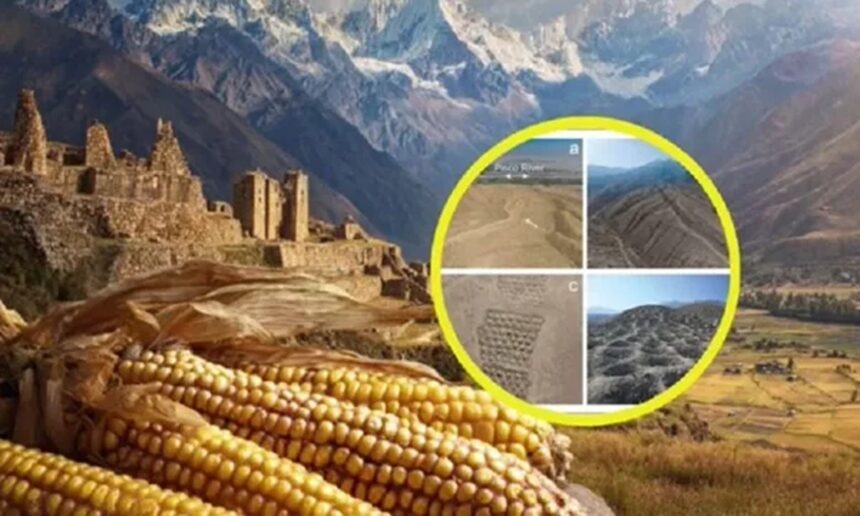
A series of approximately 5,200 holes stretching nearly 1.5 kilometers across the Pisco Valley in southern Peru has puzzled researchers for almost a century. New studies at Monte Sierpe, or “Snake Hill,” may finally shed light on why ancient peoples created these formations hundreds of years ago.
The “hole group,” as it is unofficially called, first drew attention when National Geographic published aerial photographs in 1933. Previous theories about the purpose of the holes included defense, accounting, storage, gardening, water collection, and fog trapping. Now, drone footage combined with pollen analysis found within the holes suggests the site originally functioned as a trading hub for a pre-Inca civilization, and later as an Inca accounting system, according to a study published in Antiquity, reported by KosovaPress.
“Why would ancient peoples dig more than 5,000 holes in the hills of southern Peru?” said Jacob Bongers, lead author of the study, archaeologist at the University of Sydney and researcher at the Australian Museum Research Institute.
“We don’t yet know exactly why they are here, but our new data provides significant clues and supports fresh theories about the site’s usage,” he added.
Each hole measures 1 to 2 meters in width and 0.5 to 1 meter in depth. Drone imagery shows that the holes are organized into about 60 distinct sections, separated by empty spaces. Bongers’ team also identified patterns—for example, a section with 12 rows alternating between seven and eight holes—indicating a deliberate, non-random arrangement.
Analysis of ancient pollen found in the holes points to cultivated crops like maize, as well as wild plants including reeds and bulrushes, traditionally used for basket-making. Crops and other goods may have been placed in these baskets or stored in the holes, which could have been lined with plant materials. It is possible that structures were built over or near the holes, though no evidence of permanent architecture has been found.
Researchers believe that the indigenous Chincha people, pre-Inca coastal and highland inhabitants, may have used the site for trading goods without currency. Dating of the holes suggests use 600 to 700 years ago, during Peru’s Late Intermediate Period (1000–1400 AD), aligning with pre-Inca occupation.
Pollen from citrus plants, introduced during the colonial period between 1531 and 1825, indicates that the site remained in use even after the fall of the Inca Empire in 1532. Bongers notes that the site was likely abandoned because the Spanish colonizers were unable to integrate it into their economic expansion.
Monte Sierpe may initially have contained only some sections of holes as a trading hub before later expansion under the Inca Empire. Regardless, the team believes the Incas later used the site as a large-scale accounting tool, demonstrating the complex and evolving function of this ancient site.