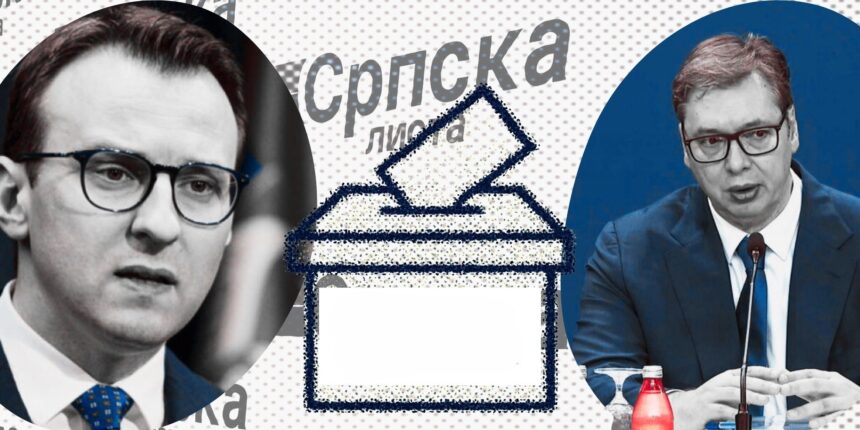
As the December 28 elections approach, the political discourse of Serbian officials has been marked by an intensified use of narratives framing the vote as a decisive moment for the fate of the Serbian community in Kosovo. Through public statements by Petar Petković and Serbian President Aleksandar Vučić, the elections are portrayed as an existential battle, centered on the political, institutional, and demographic survival of Serbs in Kosovo.
Within this framework, the Serb List is presented as the only legitimate representative and the primary mechanism of collective protection, while Kosovo’s institutions are depicted as a source of pressure, threat, and continuous risk. These narratives—built on fear, mobilization, and victimhood—create an emotional climate that shifts the debate away from political competition toward a survival-oriented and ethnically charged discourse.
Petar Petković’s Narratives: Elections as a Test of “Survival”
In the days leading up to December 28, Petar Petković, Director of Serbia’s Office for Kosovo, significantly intensified his public appearances, describing the elections as “decisive” and claiming that “the fate of the Serbian people is being decided.” In interviews given on December 26 and 27 to Serbian media outlets such as RTS and Tanjug, Petković framed the vote as a turning point for the Serbian community.
In his discourse, the Serb List is portrayed as the only political force capable of defending Serbian interests, while any alternative Serbian political option is depicted as dangerous or manipulated by Prishtina. Petković accused Kosovo authorities, led by Prime Minister Albin Kurti, of conducting a systematic policy of pressure, intimidation, and “institutional terror,” citing the militarization of the north, arrests of Serbs, and the closure of Serbian institutions.
According to Petković, the ultimate goal of these actions is the “breaking of the backbone of the Serbian people” and the elimination of the Serb List from the political scene. He also directly delegitimized alternative Serbian political actors, accusing Nenad Rašić and others of being “projects of Albin Kurti” aimed at creating the illusion of multiethnic representation while allegedly undermining Serbian interests.
Petković emphasized that only a full victory of the Serb List in all ten guaranteed parliamentary seats could ensure genuine political representation and prevent decisions that, in his words, are made against the Serbian community. He also called on displaced Serbs living in Serbia to travel and vote, framing participation as a national and moral obligation, rather than a routine democratic act.
Vučić’s Narratives: Unity, Loyalty, and Opposition to Kurti
In a similar vein, but with a more institutional tone, President Aleksandar Vučić linked electoral participation directly to national unity and Serbia’s state interests. On December 24, during a meeting with Serbian ambassadors, Vučić urged Serbs in Kosovo to vote for the Serb List, describing it as the “true defender of Serbian national interests.”
Vučić stressed that Serbian political representation requires continuous effort and energy, insisting that Serbs must be represented by “authentic representatives,” not figures aligned with Prishtina’s policies. In doing so, he positioned the Serb List as a key factor of stability and a guarantor of Serbia’s political influence in Kosovo.
On December 27, during a ceremony marking the laying of the foundation stone for a new Ministry of Defense and General Staff building in Belgrade, Vučić again called on Kosovo Serbs to support the Serb List. He expressed confidence in Serbian unity, strength, and electoral victory, portraying Serb List candidates as serious and trustworthy, while criticizing Prime Minister Kurti for allegedly attempting to secure power through “Serbian servants.”
Vučić also emphasized respect for democratic campaigning within legal boundaries, including door-to-door campaigning, which he described as a normal and acceptable political practice.
Institutional Support Measures and Mobilization of Displaced Persons
Alongside political messaging, Serbian institutions accompanied these narratives with concrete social and economic measures. On December 24, Serbia’s Office for Kosovo announced the opening of 300 new jobs in Serbian-run healthcare institutions in Kosovo, in addition to a previously announced competition for 50 more positions.
These measures were described as vital for the “survival and permanence” of the Serbian population, with officials noting that more than 1,500 people have been employed in the Serbian healthcare sector in Kosovo over the past three years. The initiatives were framed as evidence of Serbia’s care for the Serbian community, closely linked to the personal role of President Vučić.
Meanwhile, the Serbian Commissariat for Refugees and Migration called on displaced persons from Kosovo currently residing in Serbia to participate in the elections, stressing that every vote matters for protecting Serbian interests and ensuring community survival.
Conclusion
Overall, the statements of Petković and Vučić construct a shared narrative that presents the December 28 elections not as a regular democratic process, but as a critical moment for the political, institutional, and collective survival of Serbs in Kosovo. The discourse is dominated by strong emotional elements, victimization rhetoric, and ethnic mobilization, while the Serb List is framed as the sole protective mechanism against what is portrayed as systematic pressure from Kosovo’s institutions.
As a result, the electoral campaign is transformed from a political contest into an existential narrative, where voting is presented as an act of collective defense, rather than an expression of free political choice.