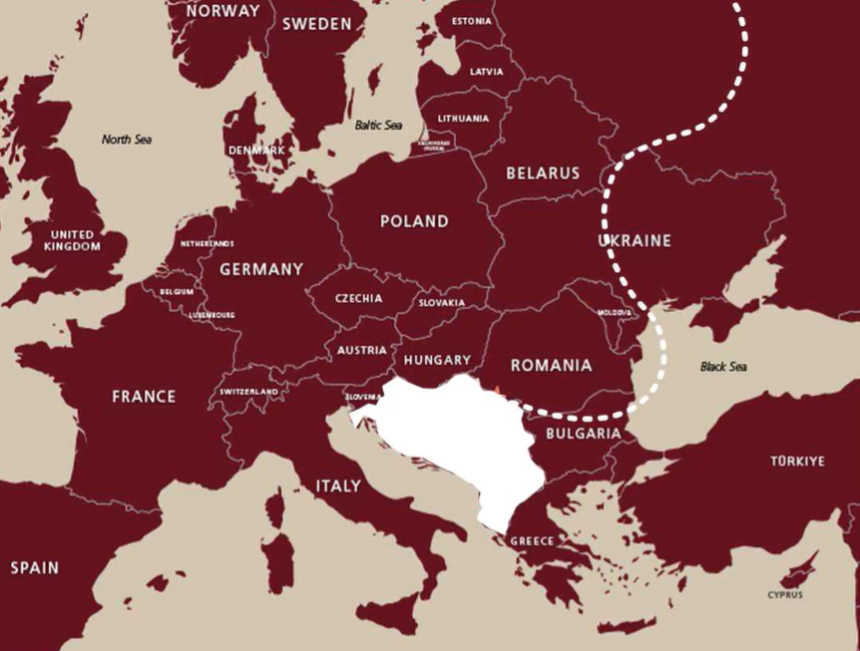
A new study published by the Belgrade Centre for Security Policy sheds light on how political elites and media actors in the Western Balkans have framed the war in Ukraine in ways that reflect local political agendas more than direct foreign influence.
The 44-page report, Political Elites and Media Narratives on the Ukraine War in Serbia, Montenegro, and Bosnia and Herzegovina, emphasizes that local political agendas and historical memory play a decisive role in shaping public discourse across the region. The findings challenge the common perception that the Balkans are passive recipients of Russian disinformation, instead showing that narratives are generated and reinforced locally to serve domestic political objectives.
Key Findings
Serbia’s Media Landscape:
- Media narratives often frame the war as a confrontation between “the West and Russia”, portraying Western countries as aggressive and Russia as a protector.
- Pro-government media outlets frequently repeat these frames, not necessarily at Moscow’s direction, but because such narratives serve domestic political and commercial interests.
- Public opinion surveys cited in the report indicate that many Serbians view NATO and the U.S. as threats, while perceiving Russia more sympathetically, a sentiment rooted in historical conflicts from the 1990s.
Montenegro and Bosnia and Herzegovina:
- In Montenegro, partisan outlets emphasize Russia-friendly narratives, while mainstream media maintain Western-aligned perspectives, creating a fragmented information environment.
- In Bosnia and Herzegovina, political divisions, particularly in Republika Srpska, foster competing portrayals of the Ukraine war, reinforcing entrenched political positions.
- Across the region, elites actively domesticate global narratives, adapting them to fit local cultural, historical, and political contexts.
Domestic Over Foreign Influence:
- The report finds that narratives persist because they align with local political needs and historical memories, not simply because of external coordination.
- Media outlets exploit the conflict to mobilize audiences politically and bolster domestic legitimacy, often invoking historical parallels and collective memory to resonate with audiences.
Broader Implications:
- Analysts highlight that this dynamic complicates efforts to counter misinformation and propaganda in the region.
- Strategies that focus solely on external influence fail to address the deeper structural and historical factors shaping public perception.
- Effective responses must engage with local political and media systems, recognizing how domestic elites frame international events to strengthen their influence.
In essence, the study demonstrates that in the Western Balkans, the portrayal of the Ukraine war reflects local political strategies as much as global conflicts, highlighting the intricate relationship between media, elites, and public perception in shaping regional narratives.