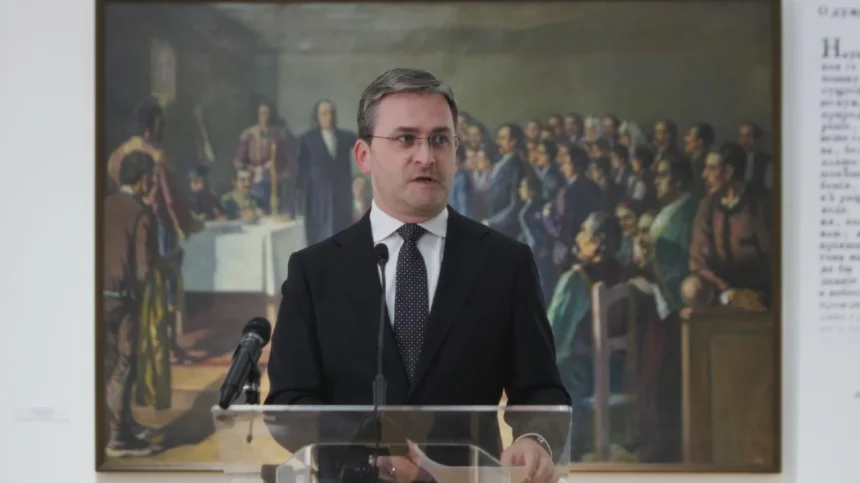
The public conduct of Serbia’s Minister of Culture, Nikola Selaković, during and after his questioning by the Special Prosecutor’s Office for Organized Crime (JTOK) has exposed far more than personal discomfort with legal scrutiny. It has laid bare the authoritarian reflexes of President Aleksandar Vučić’s political system, where institutions exist primarily to protect loyalty, not legality.
Selaković, a long-time minister and trusted figure within the ruling Serbian Progressive Party (SNS), is suspected of abuse of office and falsification of official documents—charges entirely unrelated to financial theft. Yet President Vučić rushed to his defense with a familiar refrain: “Nikola didn’t steal a single dinar.”
This statement not only misrepresents the nature of the allegations, but also signals to prosecutors, judges, and the public that legal accountability depends on presidential approval.
A Display of Contempt for Institutions
Rather than addressing the allegations with dignity, Selaković responded with theatrics, insults, and open intimidation. He accused prosecutors of being a “blockader gang” aiming to overthrow the government, branded them an “autoimmune disease of society,” and framed his questioning as an attack on President Vučić himself.
“The fact that I was summoned shows their real target is Aleksandar Vučić,” Selaković claimed—effectively asserting that any investigation into government officials is an attack on the president.
This rhetoric reflects a dangerous conflation of state, party, and individual power, where the independence of the judiciary is treated as treason rather than a constitutional principle.
Threats Against the Judiciary
Selaković went even further, openly threatening prosecutors with lawsuits and retaliation:
“They want to prosecute me – I will prosecute them.”
Such statements would trigger immediate political consequences in any democratic system. In Serbia, they are met with silence and tacit approval, reinforcing the perception that members of the ruling elite are untouchable.
Notably, no action has been taken against Selaković for publicly undermining judicial independence, while an ordinary citizen accused of verbally insulting the minister was swiftly detained for 48 hours—a stark illustration of selective justice.
A Pattern, Not an Incident
This is not Selaković’s first confrontation with accountability. As early as 2014, Serbia’s Anti-Corruption Agency called for his dismissal due to conflicts of interest involving judicial appointments. The response from Vučić at the time was unequivocal:
“I will not remove Nikola Selaković.”
Eleven years later, the same logic prevails. Oversight bodies are controlled by loyalists, the Constitutional Court routinely legitimizes abuses of power, and prosecutors who resist political pressure are publicly discredited as “enemies of the state.”
Patriotism as Performance
Selaković has long cultivated the image of a hyper-patriot—wearing traditional footwear, defending the Cyrillic script, and lamenting foreign cultural influence. Yet critics argue that this performative nationalism collapses when it conflicts with party interests.
Under his political watch, cultural heritage protections have been weakened, including decisions linked to the controversial removal of protected status from the General Staff complex in central Belgrade, enabling lucrative redevelopment deals benefiting politically connected investors.
Meanwhile, professionals who defended Serbian cultural monuments were publicly insulted and labeled “traitors”, while far-right figures were appointed to senior positions in national cultural institutions.
The System Revealed
The Selaković case is not about one minister. It is about a governing model in which loyalty replaces law, institutions serve power, and accountability is treated as sabotage.
President Vučić’s defense of Selaković—despite the gravity of the charges—confirms what critics have long warned: Serbia’s rule of law has been subordinated to the survival of the regime.
As long as ministers can attack prosecutors without consequence, and presidents can pre-judge criminal cases from television studios, justice in Serbia remains conditional, selective, and deeply politicized.