Serhii Tyschenko, a Ukrainian combat medic, spent 472 days inside a bunker.
His case appears to be an extreme example of a long-standing problem affecting Ukraine’s military.
The soldier suspected early on that this rotation on the front line would be difficult. But 472 consecutive days — underground, under fire? “I didn’t expect it to last that long,” said Sergeant Serhii Tyschenko one recent afternoon at his home outside Kyiv, Ukraine’s capital, with his wife constantly by his side. “I hoped it would be a month, two months at most.”
Instead, he spent more than a year underground, in a damp bunker without fresh air and without even a single ray of sunlight for most of that time. “Mentally, it becomes very difficult,” he said.
Long rotations have long been a problem in Ukraine’s war against Russian forces, as Kyiv struggles with troop shortages. The widespread use of drones has made the situation worse, as it is nearly impossible for soldiers to move without being detected.
But excessively long rotations damage morale and risk serious psychological harm, military experts say, potentially contributing to further manpower shortages due to desertion or exhaustion. The Ukrainian military has acknowledged the problem and pledged to address it.
“Remaining on the front line for so many days, under extremely harsh conditions, exceeds the limits of human endurance,” said retired Colonel Vladyslav Seleznyov, who served 25 years in the Ukrainian army.
“This is unacceptable,” he added. “Planned rotations must take place.”
Sergeant Tyschenko’s brigade commander, Colonel Dmytro Dobush, acknowledged that the rotation was extraordinarily long, calling him a “true patriot” who carried out an “exceptional act.”
“Such a rotation is unusually long,” Colonel Dobush said in an interview, “but under conditions of intense fighting and severe personnel shortages, such cases are not isolated. Unfortunately, these are the realities of the current phase of the war.”
“I honestly don’t know how I endured it,” Sergeant Tyschenko said. “Even today, I don’t understand how I managed.”
“I Knew They Would Take Me”
Born in a village about 50 kilometers east of Kyiv, Sergeant Tyschenko, 46, grew up in an orphanage. He said he always considered himself emotionally “very weak,” largely due to lifelong shyness.
He became a veterinarian, married, and raised five children in a home filled with rabbits and pet birds.
He was working on a dairy farm in February 2023, a year after Russia’s full-scale invasion began, when he was summoned to a military recruitment center.
“I knew they would take me,” he said.
For a man who found it difficult even to ask strangers for directions, leaving his family and adapting to military life was shocking and depressing.
He became an army medic. His first rotation on the front line later that year, in eastern Ukraine, lasted about 45 days. Two more rotations of about 30 days followed, then a short leave. His family came to visit him in the front-line city of Sloviansk.
“I didn’t expect them to come, because it was far and dangerous,” he said. “I was very happy to see them.”
It was the last time he would hug his wife and children for more than a year.
“You Start Counting Every Day”
In July 2024, he was transferred to the 30th Brigade and sent to a new position in the Donetsk region. He said he was not told how long the rotation would last. A brigade spokesperson confirmed that rotation lengths are not predetermined.
He assumed it would last 30 to 40 days at most, as before.
“You start counting every day,” he said.
He recalled the first night traveling to the position. With three other soldiers, he walked about a mile in the dark, through bushes and tall grass. Drones buzzed overhead, but he thought they were only observing.
The troops crawled into an underground bunker in the middle of a field. The bunker was less than 1.5 meters high in most places; the sleeping area was even lower — a maze of cold, damp passageways.
There were no mattresses; waterproof sleeping bags provided the only comfort. “The dampness was what you felt the most,” he said.
More soldiers arrived, bringing the group to about eight. At first, they received supplies from a nearby position, where they could call their families using satellite internet. But then things became more dangerous.
On September 16, that position itself was attacked. Several members of his unit were killed. No replacements arrived, and there was no information about reinforcements. That was when he realized he would not be going home anytime soon.
“We were already told there was no one to replace us,” he said. “It became clear to me that this would last a long time.”
“There Was No One to Replace Us”
Beginning in February 2025, Russian drone attacks intensified, and the men could no longer safely leave the bunker. Fearing detection, they covered the bunker’s small window and from that point on did not see daylight. They relied on watches and phone calendars to track time.
The Ukrainian military began delivering supplies by drone — which the men risked retrieving at night: charged batteries, canned meat, instant porridge. Tyschenko smiled recalling that one of the soldiers was a cook who radioed requests for ingredients to make pancakes. But there were also times when food and water ran low.
Throughout it all, he said, they were under attack. Russian forces threw grenades and explosive-filled cans, even reaching the edge of the trench concealing the bunker.
“We kept hoping and hoping, and it just kept dragging on,” he said. “In the end, we accepted that maybe we would only leave when the war ended, because there was no one to replace us.”
“We Just Kept Going”
While they waited, major events unfolded outside the bunker.
Ukraine launched a cross-border offensive into Russia’s Kursk region. Moscow’s forces advanced in eastern Ukraine near Pokrovsk and Chasiv Yar. North Korean troops joined the war alongside Russian forces. Ukraine received F-16 fighter jets and permission from Western allies to carry out long-range strikes inside Russia. A new U.S. president was elected. A new pope was chosen.
None of it reached Sergeant Tyschenko’s bunker. He was completely isolated. They had a radio, but it transmitted only company-level information — nothing about the wider battlefield or the outside world.
Time underground took its toll. His muscles weakened. Cramped conditions caused back pain.
Hope flared when a radio call came this autumn saying he and another soldier would soon be allowed to leave. But bad weather delayed the evacuation.
About 20 days later, they tried again. The two men crawled out into a trench filled with their own waste and the bodies of killed Russian soldiers.
Their first move was a 450-meter sprint to a nearby position with internet — the start of an exhausting journey.
“Our legs felt like cotton,” he said. “We could barely walk, but we kept going.”
When he finally emerged fully, the first thing he wanted was to shower and call his family. The real reunion came later, at home.
“I still marvel at how quickly I adapted to the conditions,” he said during half of a 30-day leave, as his wife and daughter never left his side. He was readjusting again, squinting and rubbing his eyes from the light — until a power outage plunged the room into darkness.
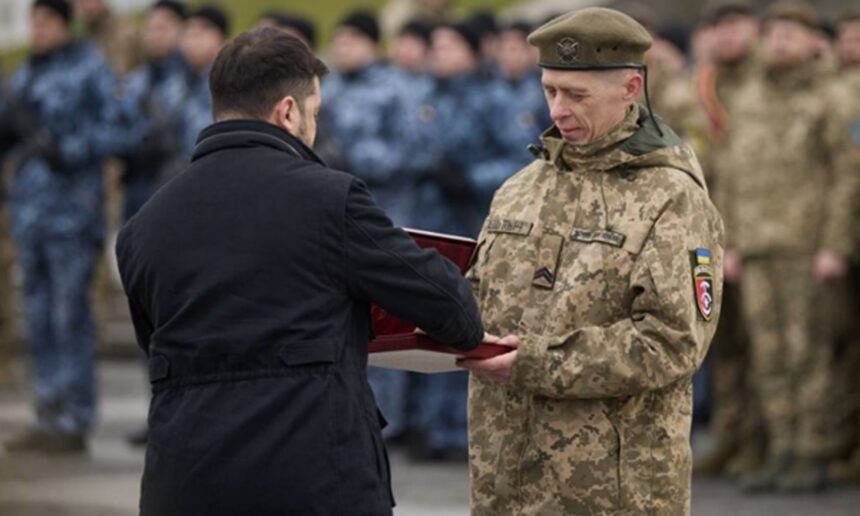
A few days later, Sergeant Tyschenko was named Hero of Ukraine, the country’s highest honor. A presidential statement cited the length and danger of his rotation.
He said his experience “is not normal,” but there was no anger or bitterness in his voice. He questioned the military value of such deployments.
“Before, if we entered combat, we could go out and act,” he said. “Now everything is dominated by drones. So does it make sense to keep people just sitting in a hole?”
Two weeks later, he took up a new post in Sloviansk, helping treat soldiers evacuated from the front line. Recently, his past and present collided when a patient arrived.
It was the pancake-making cook from the bunker — evacuated after a 10-month rotation.
Sergeant Tyschenko said he has not been told how long his current rotation will last. He hasn’t asked.