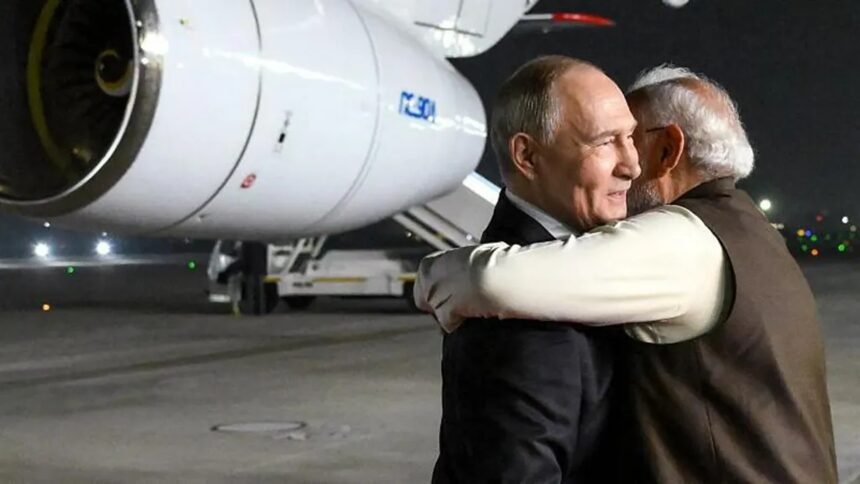
Russian President Vladimir Putin has arrived for a two-day visit to India, where he was welcomed by Prime Minister Narendra Modi ahead of an annual summit held between the two countries.
Delhi and Moscow are expected to sign several agreements during the visit, which comes months after the United States increased pressure on India to stop buying Russian oil.
The visit also comes at a moment when U.S. President Donald Trump’s administration is conducting a series of talks with Russia and Ukraine in an effort to end the war.
India and Russia have been close allies for decades, and Putin and Modi maintain a warm personal relationship. Here is why both leaders need each other — and what to watch as they meet.
A Special Partnership, Trade Deals, and Geopolitics
By Steve Rosenberg
Why are ties with India essential for the Kremlin?
To begin with, look at the numbers:
- a population of nearly 1.5 billion
- economic growth exceeding 8%
- the world’s fastest-growing major economy
This makes India an extremely attractive market for Russian goods and resources — especially oil.
India is the world’s third-largest consumer of crude oil and has purchased enormous volumes from Russia. Before Moscow’s full-scale invasion of Ukraine, only 2.5% of India’s oil imports came from Russia.
That figure later jumped to 35%, as India took advantage of discounted Russian prices caused by Western sanctions and Russia’s restricted access to the European market.
India was pleased. Washington was not.
Earlier this year, the Trump administration imposed an additional 25% tariff on Indian goods, arguing that by purchasing Russian oil, India was helping finance the Kremlin. Since then, India’s orders of Russian oil have declined — and President Putin is eager for them to continue.
For Moscow, arms sales to India are another long-standing priority. Ahead of Putin’s visit, reports suggested that India plans to purchase advanced Russian fighter jets and air-defense systems.
Russia, struggling with labor shortages, also sees India as a valuable source of skilled workers.
But geopolitics is just as important.
The Kremlin relishes demonstrating that Western efforts to isolate Russia over the war in Ukraine have failed.
Flying to India to meet Prime Minister Modi is one way to make that point.
So was Putin’s visit to China three months ago, when he met Xi Jinping — and Modi — on the same trip. Photos of the three leaders smiling together sent a clear message: despite the war, Moscow still has powerful allies who support a “multipolar world.”
Russia praises its “no-limits partnership” with China.
It is equally vocal about its “special and privileged strategic partnership” with India.
This stands in stark contrast to Moscow’s broken relationship with the European Union.
“Russia is now completely isolated from Europe. This is unprecedented,” says Andrei Kolesnikov of Novaya Gazeta. “Many in Russia’s political and business elite dream of returning to Europe and doing business not only with China and India.”
But this week, expect to hear about Russia–India friendship, new trade deals, and expanded economic cooperation.
A Test of Modi’s Strategic Autonomy
By Vikas Pandey
Putin’s visit comes at a crucial moment for Modi’s global ambitions and for India’s geopolitical positioning.
India-Russia ties date back to the Soviet era and have survived dramatic shifts in global politics. Putin has arguably invested more time and attention in the relationship than any other Russian leader before him.
For Modi, despite heavy pressure from Western governments to condemn Russia’s war in Ukraine, he has insisted that dialogue is the only path to resolving the conflict.
This reflects India’s doctrine of strategic autonomy — maintaining close ties with Moscow while also nurturing relations with the West.
This balancing act worked… until Trump returned to the White House.
India–U.S. relations have hit a low point in recent months, with the two countries unable to resolve a tariff dispute.
In this context, Putin’s visit is more important to Modi than ever before — because it will test India’s geopolitical independence.
Modi wants to show both Indian citizens and the world that he still considers Putin a key ally and has not bowed to Trump’s pressure — the same Trump he once called his “true friend.”
But he is also facing pressure from European allies. Just this week, the German, French, and British ambassadors to India published a rare joint article criticizing Russia’s actions in Ukraine.
Modi must therefore ensure that deepening India–Russia ties does not overshadow negotiations with the U.S. or his partnerships in Europe.
India’s challenge, analysts say, is strategic balance — defending autonomy while managing U.S. pressure and dependence on Russia.
Trade, Defense, and What Modi Wants
Modi’s next priority is unlocking the potential of India–Russia trade.
Despite decades of close political ties, economic cooperation has long underperformed.
Bilateral trade jumped from $8.1 billion in 2020 to $68.72 billion in 2025, driven overwhelmingly by India’s discounted oil purchases — creating a massive trade imbalance in Russia’s favor.
With Indian companies now reducing imports of Russian oil to avoid U.S. sanctions, the two countries must explore new areas for growth.
Defense is the simplest answer.
India’s imports of Russian military equipment fell sharply in recent years as the country diversified suppliers and expanded domestic production. Yet many core Indian defense platforms — including much of its Sukhoi-30 fighter fleet — remain deeply dependent on Russia.
India is reportedly interested in purchasing Russia’s upgraded S-500 air-defense system and the Su-57 fifth-generation fighter jet, especially after Pakistan acquired China’s J-35 stealth aircraft.
But Russia faces shortages of critical components due to sanctions and the war in Ukraine. Deliveries of the S-400 system have already been delayed until 2026. Modi will seek assurances from Putin on deadlines.
Modi also wants Russia to open its consumer markets to Indian products — from electronics to food — to correct the huge trade imbalance.
As the Global Trade Research Initiative (GTRI) notes, India’s presence in Russian retail markets remains “marginal.”
Modi aims to position Indian goods competitively in Russia, especially once the war ends and Moscow reintegrates into the global economy.
His broader goal: reduce dependence on oil and defense while shaping a trade relationship that strengthens ties with Russia without alienating the West.
Conclusion
According to GTRI, “Putin’s visit is not a nostalgic return to Cold War diplomacy — it is a negotiation over risk, supply chains, and economic isolation. A modest outcome will secure oil and defense. An ambitious one could reshape the regional economy.”