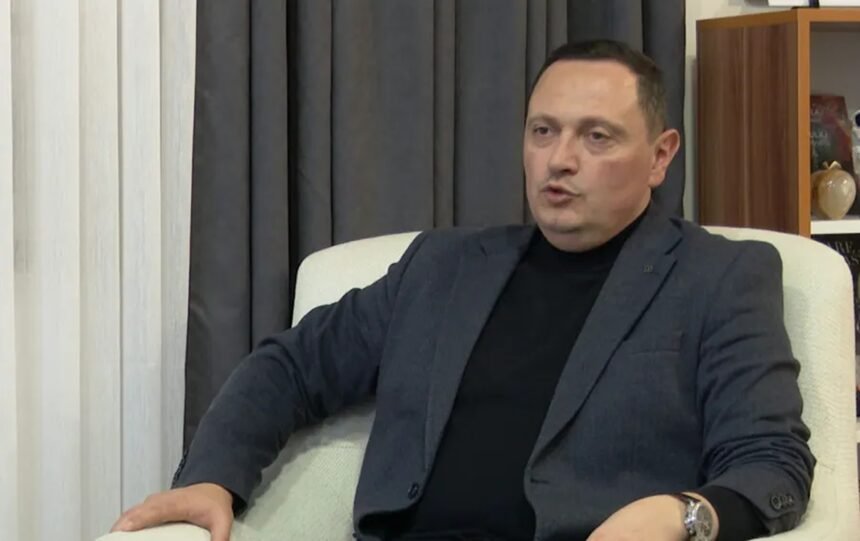
The Mayor of Bujanoc, Arbër Pajaziti, has raised concerns about the discrimination of Albanians by the Serbian state. He says that in many state institutions in the Presheva Valley, there is not a single Albanian employee.
In an interview, Pajaziti highlights the Cadastre Office in Bujanovac, noting that throughout the history of this institution, there has never been an Albanian employee, even though it operates inside the municipal building. He also criticizes the allocation of funds for the Presheva Valley, expressing dissatisfaction with the lack of tangible results on the ground. According to him, these funds are ending up “in the pockets of party militants and members of a political party.”
Arbër Pajaziti, who leads the municipality of Bujanoc, says the past year has been challenging due to the heavy debts inherited from the previous administration.
“The year 2025 was full of challenges for the Municipality of Bujanovac, because 2024 was an election year and we inherited a very poor financial situation. We focused on recovering the damage left by the previous governance. Cleanliness in the city and villages was declared a priority, and we worked hard to remove illegal landfills and restore order and cleanliness. There is still much work to be done, but we have made significant progress.
However, we faced obstacles with subsidies for farmers, businesses, and student scholarships due to the financial situation we inherited. We took over the municipality with around 3 million euros in debt, which we have now reduced to about 1 million euros, carried over into 2026. Overall, we have addressed most of the priorities we set for last year,” Pajaziti stated.
The municipality has also been affected by emigration, he adds, noting that many businesses are facing labor shortages.
On the other hand, Pajaziti emphasizes that since 2015, the monthly transfers from the Serbian state have remained unchanged, while more than 45 percent of the municipal budget goes toward salaries, leaving less than 1 million euros for capital investments.
“We have never had problems with local Serbs not in the past, not during the conflict, and not during the time of the UÇPMB. There has never been conflict with local Serbs. Our problems have always been with the government, the police, and the army. Bujanoc is an example of tolerance and coexistence, and we strive to promote this.
However, cooperation with the state is always problematic, because many Serbian politicians and officials from central Serbia do not understand how we function here. They often come with provocative and inflammatory statements that fuel tensions,” Pajaziti said.
Pajaziti, from the Alternative for Change party, stresses that Albanians continue to face discrimination in employment within state institutions.
“Since I became mayor, we have had seven or eight cases where Albanians were employed in state institutions. But this number is negligible compared to others. Take the Cadastre Office in Bujanoc as an example it is a state institution operating inside the municipal building, and in its entire history it has never employed a single Albanian. Even today, there are none.
They bring Serbs from Vranje, Vladičin Han, Surdulica, and other municipalities, but they do not employ Albanians from Bujanoc. The same applies to the courts and other state institutions where the municipality has no authority. Either the number of Albanians is extremely low or there are none at all,” he said.
Regarding these discriminations, Pajaziti says the international community is aware, but concrete results are lacking.
Speaking about political initiatives concerning the Presheva Valley, Pajaziti says that despite repeated efforts, there has been no real progress.
“We have heard statements from Kosovo officials insisting that the Presheva Valley be included in the dialogue, and we have heard Serbian representatives rejecting this every time. There are initiatives, but the result remains zero. Repeating the same actions and expecting different results makes no sense.
Albania has also officially raised the issue in international forums. We welcome these initiatives, but on the ground, we remain stuck. There is no progress. Still, we encourage continued efforts, because we must always demand the rights guaranteed by the constitution and international frameworks,” he stated.
Regarding funds allocated by the Government of Kosovo for the Presheva Valley, Pajaziti says they have not produced results.
“Since 2022, the Presheva Valley has had a budget line from the Government of Kosovo from 2 to 4 million euros. However, only the funds from 2022 were implemented. Those ‘famous’ 2 million euros ended up in the pockets of officials from one political party.
Today, in 2026, I asked young people to show me just one sign of where that money went and no one could. Kosovo is allocating funds, but there is no trace of them on the ground. Meanwhile, we have less than 1 million euros for investments, and you can see those every day in the field.”
He adds that cooperation is lacking and that funds are either being blocked or diverted.
“We offered a solution for the funds to be transferred to the Municipality of Bujanoc so they could be distributed transparently to farmers, but this was rejected. What I see is not support for the citizens of the Presheva Valley, but support for a political party. As a result, either the funds go into militants’ pockets or they never reach the people at all.”
Pajaziti also spoke about the passivization of addresses, which he says has affected the entire Presheva Valley, including Bujanoc, Presheva, and Medvegja.
“Passivization began in 2011. To this day, there is no exact number of how many people have been affected. Based on our analysis, between 8,000 and 9,000 citizens have been passivized. These are mainly people temporarily living or working in Kosovo. Those living in Switzerland, Germany, or Austria are not affected.
Even if passivization stops today, if the situation is not restored to how it was in 2011, nothing will change. What is happening is ethnic cleansing through legal means.”
The Mayor of Bujanoc concludes that priorities for this year include youth support, infrastructure investments, combating pollution, and ensuring access to drinking water.