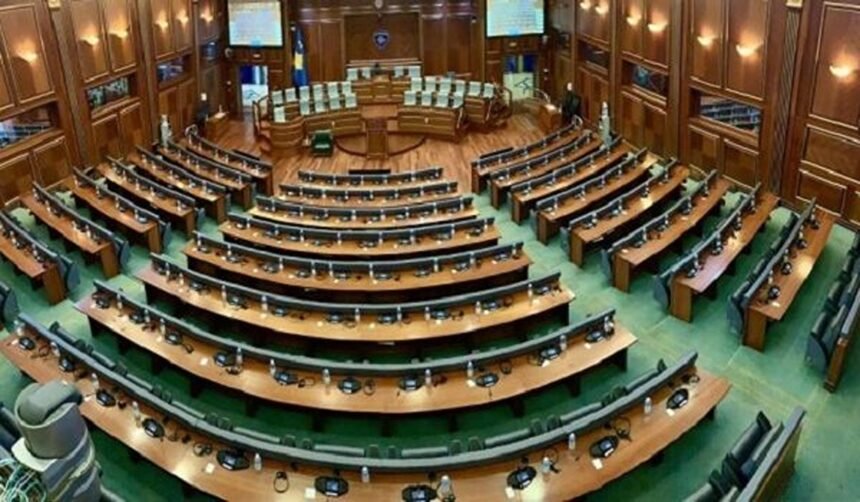
A political deadlock in Kosovo’s Assembly is threatening the ratification of several key international agreements worth €121 million, raising concerns about delays to major development projects and potential damage to the country’s credibility with international partners.
The Assembly has until 31 March to ratify a €33 million loan agreement between Kosovo and the European Investment Bank for the “Photovoltaic Solar Energy” project at the Kosovo Energy Corporation (KEK). However, parliamentary activity has been effectively frozen following a temporary measure imposed by the Constitutional Court after a legal challenge to President Vjosa Osmani’s decree dissolving the tenth legislature.
The solar energy project is one of eight international agreements currently awaiting ratification in the Assembly. Among them are Kosovo’s accession to the Peace Board, an agreement facilitating access to higher education across the Western Balkans, two amendments to financial agreements with the European Union under the IPA program, and two loan agreements with the European Bank for Reconstruction and Development for energy efficiency in public buildings and wastewater treatment facilities in Podujevë. Another loan agreement with the Saudi Fund for Development concerns the Prishtina–Mitrovica road project.
Four of these agreements alone represent a combined value of €121 million.
Government spokesperson Arlind Manxhuka told Radio Free Europe that the deadlines for approving these agreements are tight and require swift action from the Assembly. The European Investment Bank also emphasized that ratification is essential for the financing to proceed.
If approved, the solar project would enable Kosovo to construct one of its largest photovoltaic power plants, with a capacity of up to 100 megawatts. The facility is expected to strengthen energy security, expand domestic renewable energy production, and reduce reliance on coal-based power generation. Once operational, it could generate approximately 169 gigawatt-hours of electricity annually while significantly lowering carbon dioxide emissions.
Experts warn that the continued institutional blockage creates uncertainty for both domestic governance and international cooperation. Violeta Haxholli, a researcher at the Kosovo Democratic Institute (KDI), said that because international agreements must be ratified with a two-thirds parliamentary majority, any disruption in legislative functioning automatically delays the process.
Melos Kolshi, a researcher at the Kosovo Law Institute (IKD), noted that such agreements play a direct role in improving citizens’ quality of life and strengthening Kosovo’s international standing. He added that delays risk slowing public investments and weakening institutional stability.
According to the ruling party Vetëvendosje, the agreements had been scheduled for approval on 6 March, one day after the failed attempt to elect a new president. The parliamentary session did not take place after President Osmani issued the decree dissolving the Assembly that same morning.
Vetëvendosje parliamentary group leader Arbërie Nagavci described the agreements as crucial for economic development, infrastructure improvement, environmental protection, and energy efficiency. She stressed that strategic projects should not become hostages of political disputes.
Analysts also warn that failure to ratify the agreements could undermine Kosovo’s reputation among international partners. While foreign institutions often understand domestic political challenges, prolonged institutional blockages could affect the pace of cooperation and confidence in implementing joint projects.
Kosovo has faced similar risks in the past. During the current legislature, authorities barely met the deadlines required to secure funding agreements with the World Bank and the European Union under the Growth Plan framework, worth nearly €1 billion in total.