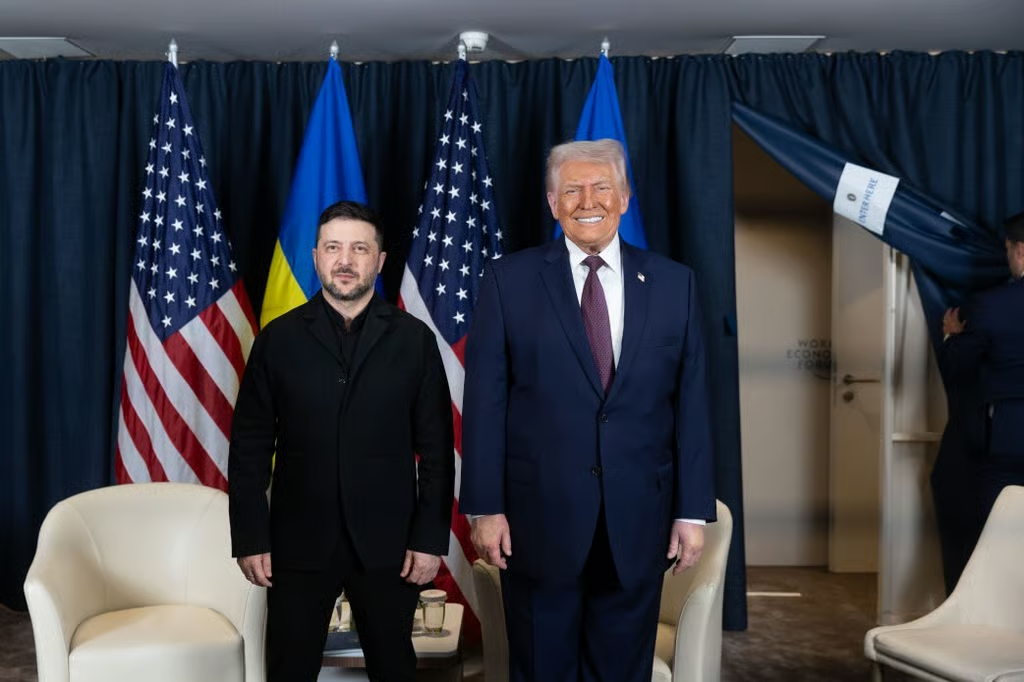
As U.S.-brokered talks to end the war in Ukraine prepare to resume, Moscow and Kyiv remain deadlocked over the fundamental issues that have defined the conflict since 2022.
Ukrainian President Volodymyr Zelenskyy said his team could meet with Russian and American officials as soon as Sunday, expressing willingness to negotiate directly with Russian President Vladimir Putin. However, Foreign Minister Andrii Sybiha admitted that “the most sensitive issues are still unresolved.”
Despite U.S. envoy Steve Witkoff suggesting last week that only one “solvable” issue remained, the UAE talks revealed three major points of contention:
1. Territorial Disputes
The fate of Donbas in eastern Ukraine remains the primary obstacle. Russia demands that Ukraine cede all of Donbas, in addition to the already annexed Crimean Peninsula, under a framework known as the “Anchorage formula.” Kyiv views any surrender of territory as illegal and politically untenable, though Zelenskyy has floated a demilitarized “free economic zone” as a potential compromise, which Russia rejects.
U.S. Secretary of State Marco Rubio acknowledged that the territorial question is still a significant hurdle, while the Zaporizhzhia nuclear plant near the frontline also remains disputed, with Kyiv proposing joint control with the U.S. and Russia demanding its own stake in any agreement.
2. Security Guarantees
The second sticking point concerns Ukraine’s post-war security. The U.K. and France have pledged to deploy troops once a deal is reached, but Moscow rejects any NATO presence and demands its own security guarantees, including limiting Ukraine’s army to 600,000 troops and securing a veto over future defense decisions.
Meanwhile, the U.S.-led 20-point plan envisions Ukraine joining the European Union by 2027, which carries collective defense obligations. Moscow continues to insist that Ukraine’s NATO ambitions must be permanently blocked.
3. Ceasefire Timing
Kyiv demands an immediate cessation of hostilities, while Moscow insists a deal must be signed before any pause in fighting. Until then, Russian missiles continue to strike Ukrainian infrastructure, including a recent attack on a passenger train that killed five people.
Key Differences and Outlook
While both sides present a cooperative front to the U.S., analysts note a stark contrast: Ukraine is willing to negotiate, but Russia appears to be stalling while maintaining its goal of subjugating Ukraine.
Tatiana Stanovaya, founder of R.Politik, warns that Russia’s insistence on obtaining all of Donbas is likely a stalling tactic, while Ukraine may struggle politically to give up the region, even if Zelenskyy were willing.
Polls indicate that Ukrainians are open to a fair deal, but trust in U.S.-led negotiations has declined. Zelenskyy aims to be remembered as the president who saved Ukraine, not the one who lost the war.