If negotiations between Moscow and Kyiv have stalled for months over territorial issues, what fuels Donald Trump’s hopes and satisfies Vladimir Putin’s ambitions is a 50-kilometer stretch of fortifications, trenches, barbed wire, and dragon’s teeth extending between Kramatorsk and Sloviansk, passing through Druzhkivka and Kostiantynivka along highway H-20.
The Kremlin understands that capturing the entire Donetsk region without firing a single shot after 45 months of war would mean inheriting a fortress built at Ukraine’s expense over 11 years a springboard for further advances into Kharkiv and Dnipropetrovsk. This represents a considerable saving in financial and manpower resources.
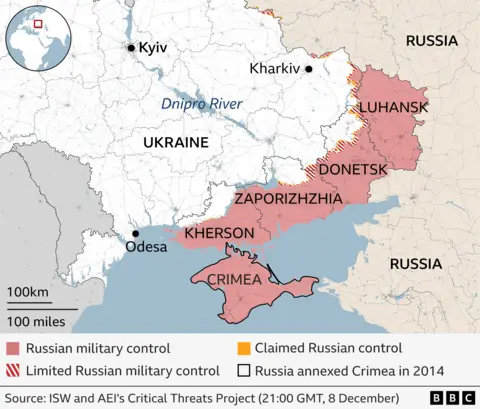
To fully control Donetsk, Moscow would need to seize nearly 7,000 square kilometers about one-third of the region, home to roughly a quarter of a million people a daunting military task. Historically, the battle for Bakhmut, which lasted nearly a year, cost tens of thousands of Wagner mercenaries and Russian soldiers. The Avdiivka offensive required 120,000 troops, with irreversible losses estimated at one in three. Toretsk has been under siege for months. Cities such as Kostyantynivka and Chasiv Yar continue to resist, blocking Russian advances.
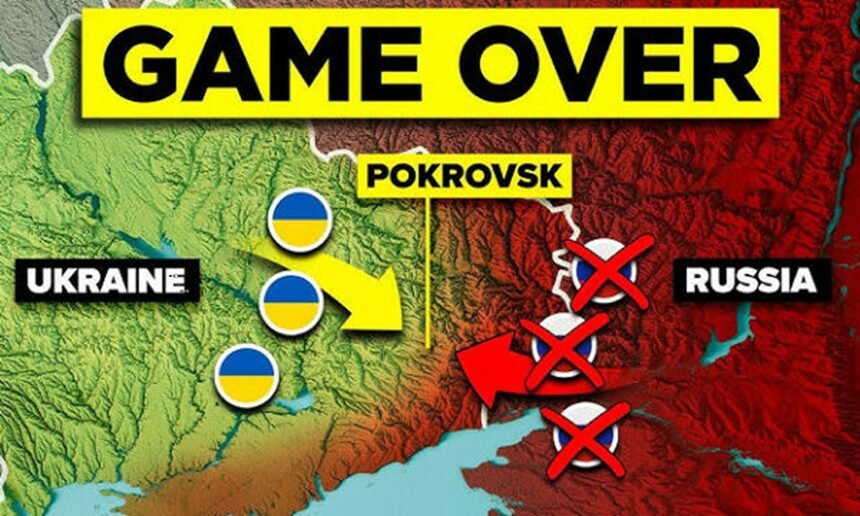
The battle for Pokrovsk, dubbed the “gateway to Donetsk,” has also entered its second year. Despite repeated Russian claims, BBC reported yesterday that Ukrainian troops raised the Kyiv flag in the northern part of the city a reminder of the propaganda war often fueled by unverifiable images.
Casualty figures remain shrouded in uncertainty. According to Kyiv, Moscow deployed around 170,000 troops for Pokrovsk a figure experts describe as colossal. By comparison, the entire active German army numbers about 180,000, while Poland has roughly 200,000.
In November, over 6,500 Ukrainians were reported killed in Pokrovsk, according to the Russian Telegram channel “SHOT.” Russian losses in 2025 alone the worst year since the start of the war are staggering: 392,000 killed or wounded, expected to surpass 400,000 by year-end. These figures add to 790,000 casualties from the past three years, with a current daily death rate exceeding 1,200 soldiers.
Despite deploying more troops and infantry, Moscow remains far from its goal of capturing Donetsk. Encircling cities such as Kramatorsk and Sloviansk at the current pace would require at least another two years and hundreds of thousands of lives, as well as millions of rubles in military equipment.
Beyond these logistical challenges, many analysts argue that yielding Donetsk would be both irrational and immoral. In 2014, the international community turned a blind eye as Russia annexed Crimea. In 2022, Putin launched the largest war in Europe in 80 years, calling the Donbas “Russian territory” while ignoring centuries of local conflict that had made the region a hub of instability.
A territorial concession would repeat the mistakes of 1938, when Hitler annexed part of Czechoslovakia following the Munich Agreement, precipitating World War II. Granting Putin’s ambitions would not halt him; it would simply legitimize further expansion.
Other observers note that territorial concessions can sometimes serve as a reasonable price for peace, as in 1918 when Germany ceded Alsace-Lorraine to France, ending World War I, or in 1944 when Finland gave up parts of Karelia to the Soviet Union under the Moscow Armistice, and again in 1953 at the end of the Korean War.
It is a difficult dilemma, representing one of the most critical diplomatic and military challenges of recent decades.