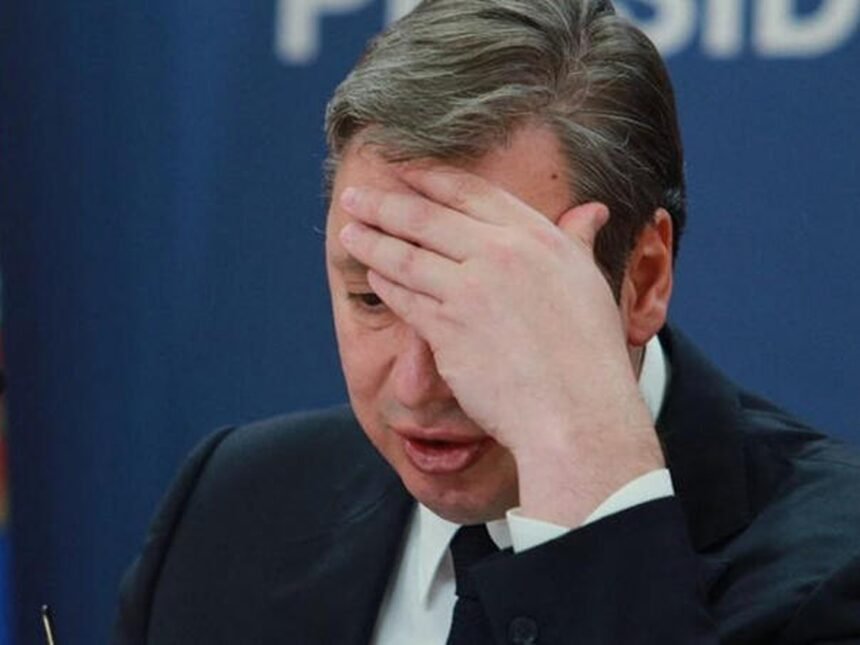
New demands from the European Union and NATO are increasing political pressure on Serbian President Aleksandar Vučić, as unresolved security incidents in Kosovo and Serbia’s continued reliance on Russian energy place Belgrade under growing international scrutiny.
In a single day, Serbian authorities faced two significant diplomatic signals. NATO Secretary General Mark Rutte stated in Brussels that the alliance expects Serbia to establish accountability for the 2023 incidents in northern Kosovo, including the armed clash in Banjska and the attack on KFOR troops in Zvečan.
Speaking before joint sessions of the European Parliament’s committees on foreign affairs and security and defence, Rutte said NATO remains firmly engaged in the Western Balkans and reiterated its long-standing position on the incidents.
“I have a personal relationship with President Aleksandar Vučić. We have known each other for many years. But we expect full accountability for what happened a few years ago, on both issues. He has promised that responsibility would be fully established,” Rutte said.
NATO officials have repeatedly emphasized that those responsible for the attacks on Kosovo police officers and KFOR personnel must be brought to justice, a demand that remains unresolved.
EU Moves to Ban Russian Gas Imports
Only hours later, the EU Council agreed on a plan to completely ban imports of Russian liquefied natural gas from January 1, 2027, while a ban on Russian pipeline gas is set to take effect on September 30, 2027.
EU officials described the move as a key step within the REPowerEU strategy, aimed at permanently ending Europe’s dependence on Russian energy sources.
According to Vladimir Međak of the European Movement in Serbia, the decision will become a binding accession condition for EU candidate countries, including Serbia.
“This becomes an obligation for us, regardless of when membership happens. If the EU stops importing Russian gas, countries like Hungary and Bulgaria will no longer be able to buy it either, leaving Serbia isolated. The question is whether gas transit through Serbia could also be banned,” Međak said.
He added that the demand for accountability over the Kosovo incidents has never been removed from the agenda, and that it is now a matter of political timing before pressure intensifies further.
Broader Challenges for the Serbian Government
The EU and NATO demands come amid a broader accumulation of political and economic challenges for Vučić’s government.
During the World Economic Forum in Davos, U.S. President Donald Trump announced investigations into alleged election interference linked to the 2020 U.S. election, again raising attention to companies connected to Serbia. One such case involves the Serbian firm Roaming Networks, which previously cooperated with Dominion Voting Systems before being sold to a businessman close to the ruling SNS party and subsequently rebranded.
Additionally, the U.S. Congress recently adopted the Western Balkans Democracy and Prosperity Act, which explicitly mentions Serbia and includes provisions for sanctions against political actors involved in corruption or violations of democratic standards.
Serbia is also still facing uncertainty over the future of Naftna Industrija Srbije (NIS), with no confirmation yet on whether Washington will approve a restructuring of Russian ownership stakes.
Meanwhile, a recent European Parliament monitoring mission reportedly left Serbia with serious concerns over repression, political pressure, intimidation, and media freedom, findings expected to influence future assessments by the European Commission.
As international scrutiny intensifies, analysts warn that Serbia’s room for political maneuvering is narrowing, with unresolved security issues, energy dependence, and democratic standards increasingly shaping its relations with Western partners.