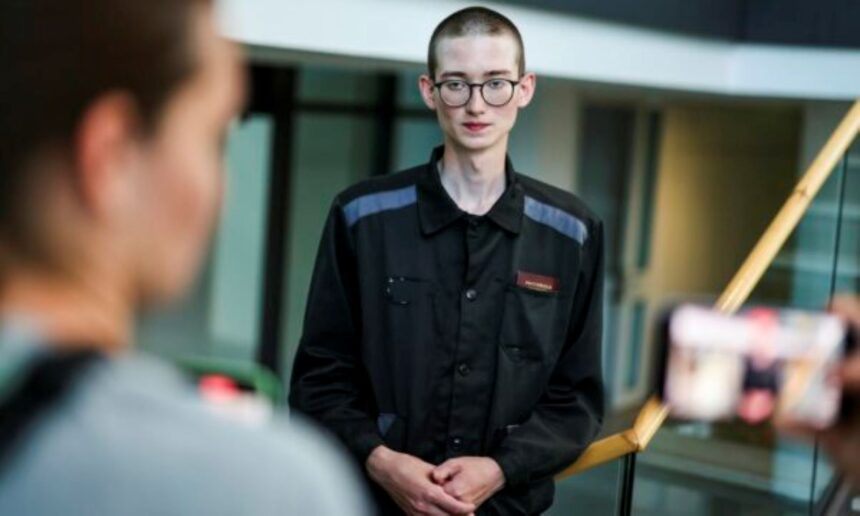
A simple social media video showing a teenager holding a sign reading “Freedom for political prisoners” and “I am against Putin” resulted in a severe prison sentence.
Arseny Turbin was only 14 years old when he was handed a five-year prison term for his act of defiance. His “crime”: courage.
Now 17, Turbin is considered one of Russia’s youngest political prisoners. He has been transferred to a penal colony in Perm, more than 1,800 kilometers from his home, making it extremely difficult for his mother, Irina Turbin, to visit. He reports violence from other inmates and deteriorating physical and mental health — a reflection of the systemic repression within the Russian penal system.
A DW documentary titled Politzek, supported by human rights activist Anna Karetnikova, exposes the brutality and humiliation that define Russia’s detention camps: a system built on fear, intimidation, and isolation.
The Russian term “Politzek” means political prisoner, and also serves as the title of the documentary Politzek: Voices Challenging the Kremlin, released on 27 November. Co-produced by DW in cooperation with France TV, RTBF, VRT, and SWR, the film is directed by Manon Loiseau, Ekaterina Mamontova, and Sasha Kulaeva.
Filmed secretly over the course of a year, the documentary focuses on the personal stories of detainees and the struggles of their families. One of the featured cases is artist Sasha Skotsilenko, sentenced to seven years in prison for placing anti-war stickers in supermarkets.
The documentary also follows Oleg Orlov, co-founder of the Memorial human rights group and 2022 Nobel Peace Prize laureate, who was imprisoned in 2024 for allegedly “discrediting the Russian army.”
Despite a few prisoner exchanges that have freed some dissidents, many remain behind bars. According to Russian NGO OVD-Info, there are currently 1,586 political prisoners in Russia, including film director Zhenya Berkovich and writer Svetlana Petrychuk.
The documentary also highlights the 2021 theatrical production “Finist, the Brave Falcon”, which addressed the recruitment of Russian women by ISIS in Syria. The play received two Golden Mask awards, yet the actresses were each sentenced to six years in prison for “justifying terrorism” — another stark example of the Kremlin’s war on free expression.
Politzek is not only a portrait of repression but also of solidarity. Russian dissidents abroad send letters and messages of support to help political prisoners endure isolation, a lifeline that often proves crucial — as in the case of pianist Pavel Kusnir, who died in prison after a hunger strike but became a symbol of the anti-war movement.
Just like Alexei Navalny, who died in a penal colony in 2024, these activists leave behind a powerful legacy — voices of resistance and hope in a country that punishes everyone who dares to challenge authority.