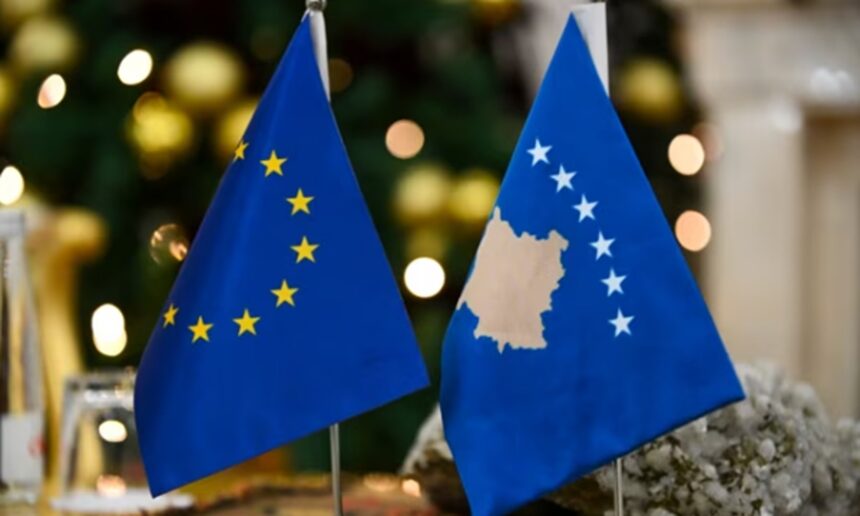
Despite a peaceful transfer of power in the four northern municipalities with a Serb majority on December 5, EU member states appear divided on lifting sanctions against Kosovo. For some time, Kosovo officials, including the President, have considered the continuation of these measures entirely unjust. But could Kosovo have done more?
When the European Union imposed sanctions on Kosovo in the summer of 2023, following tensions in the Serb-majority north, they were described as temporary, with clear conditions for their removal.
Kosovo officials insist that the EU’s demands for lifting the measures, which have cost the country millions, have been met: tensions in the north have eased, police presence near municipal buildings has decreased, Serbs participated in this year’s elections, and the peaceful transfer of power in Serb-majority municipalities was achieved.
However, recent reports from Kosovar media, citing EU sources, indicate that countries such as France and Italy, supported by Spain, Hungary, and Slovakia, are unwilling to remove the sanctions entirely.
Rikard Jozwiak, Europe editor for Radio Free Europe (RFE) in Prague, notes that discussions on not lifting all measures took place in Brussels this week, with France and Italy supporting the removal of only 50% of the sanctions.
Paris reportedly insists on this position because it wants Belgrade to open EU accession chapters and is frustrated that others are blocking the process.
“There is also a general argument that Brussels cannot give this ‘gift’ to [Kosovo’s acting Prime Minister Albin] Kurti before the December 28 elections. Whether this is a valid argument or not has been questioned by others, as the main opposition party [Democratic Party of Kosovo] recently sent a letter to [EU Commission President Ursula] von der Leyen, requesting the full removal of measures immediately. So, it is not perceived as a gift for Kurti by anyone except a small number of EU states,” says Jozwiak.
An EU spokesperson told REL that the bloc intends to continue the process of lifting measures, which began partially in May this year.
According to the spokesperson, Brussels is ready to work with Kosovo authorities once they are formed and expects Kosovo to return to the necessary reform path linked to the EU.
For Kosovo’s acting government, the early parliamentary elections have no connection to the sanctions.
“Any further delay only deepens the absurdity of the measures and undermines the EU’s credibility. Our position is that the measures should be removed immediately and completely,” says Klisman Kadiu, media advisor to Acting Deputy Prime Minister Besnik Bislimi, in written responses to REL.
President Vjosa Osmani also described the continuation of the EU sanctions as “inexplicable, unfair, and unreasonable” during a meeting this week with Kosovo rapporteur in the European Parliament, Riho Terras. Terras also stated that the measures should be lifted immediately.
Could Kosovo have done more?
Describing the continuation of EU measures as a total absurdity, Besar Gërgi of the Group for Legal and Political Studies (GLPS) says Kosovo lost valuable time this year due to the absence of new institutions and could have worked harder to get the sanctions lifted.
Gërgi believes that forming new institutions is a prerequisite for removing the measures, and engaging with hesitant EU members should be a priority. He stresses that today, politics is driven less by moral considerations and more by political interests.
“The new government needs to actively work with allies. Unfortunately, there was little communication this year; the focus was on building internal numbers, which caused delays in Kosovo’s foreign policy. Therefore, a functional government is the minimum requirement,” he told REL, noting the need to adopt agreements with the EU, such as the Growth Plan, as soon as possible.
According to him, time was also lost by not addressing the technical aspects of European integration. Kosovo applied for EU membership in 2022, but its application has never been reviewed, leaving it the only Western Balkan country without candidate status.
Gërgi adds that, besides lack of communication, increased hesitancy from some countries was influenced by the Central Election Commission’s decision to bar the Serbian List, the largest Serb party in Kosovo, from participating in the parliamentary elections.
How much has Kosovo been affected by the measures?
According to an analysis by the Institute for Advanced Studies – GAP, EU sanctions have cost Kosovo approximately €613.4 million in postponed or indefinitely delayed projects. Due to missed deadlines, €7.1 million was lost entirely.
The most affected sectors include environment (€350 million), energy (€114 million), digitalization (€57 million), and culture (€15 million).
Of these funds, around €218 million were for projects under the Pre-Accession Instrument (IPA II and IPA III), and approximately €395 million under the EU Western Balkans Investment Framework (WBIF).