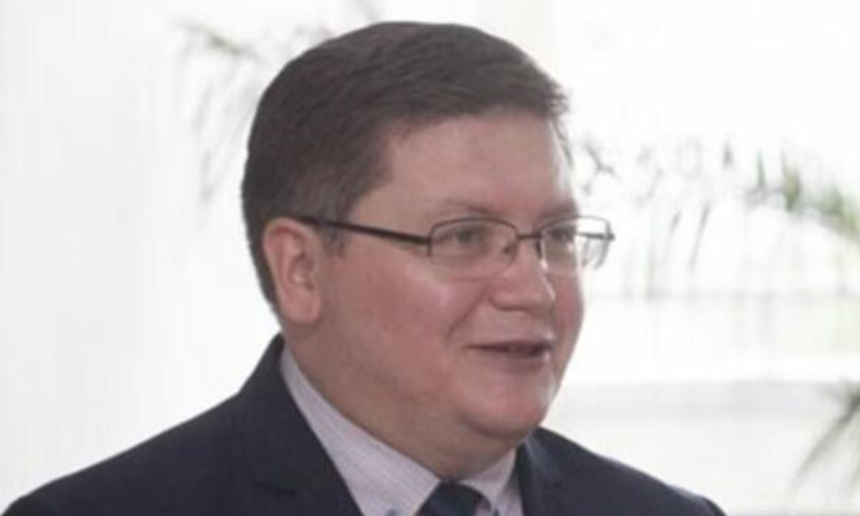
Radio Free Europe/Radio Liberty has found that the name of Ilia Uvarov, the new head of Russia’s Liaison Office in Pristina, appears in a database published by the Ukrainian organization Molfar Intelligence Institute, which includes individuals suspected of links to Russian intelligence services. RFE/RL has not been able to independently verify the claim regarding his exact role.
In an office that has operated largely quietly for years in Pristina, Russia appointed a new chief.
In August 2025, through a brief announcement, the UNMIK stated that the then Special Representative of the UN Secretary-General had received the new head of Russia’s Liaison Office in Pristina, Ilia Uvarov. The meeting was described as a “general and constructive discussion.”
Beyond this formal notice, Uvarov has remained a relatively unknown figure to the public in Kosovo.
Even on the website of the Ministry of Foreign Affairs and Diaspora of Kosovo, where foreign diplomatic missions are listed, he is still not officially registered as the head of the office. His predecessor, Andrei Shugurov, remains listed.
Meanwhile, Uvarov’s name appears in the updated list of foreign missions in Serbia—a practice linked to Serbia’s position that considers Kosovo part of its territory, with some non-recognizing states managing diplomatic relations through Belgrade.
What places Uvarov’s name in a broader context is a database published by the Molfar Intelligence Institute, which conducts open-source intelligence analysis and, in some cases, uses leaked Russian documents.
In this database, Ilia (Ilya) Uvarov is described as an “officer of the RT (territorial intelligence) department of the SVR.”
According to the organization, the database is based on materials obtained from an internal source within a Moscow-based tech company and includes names of diplomats and intelligence personnel. Some data has been cross-checked with state registries, though full confirmation of specific roles remains difficult.
Molfar told RFE/RL that the RT department is linked to intelligence operations conducted from Russian territory, often using diplomatic or institutional cover to establish contacts with foreign officials, business figures, and others.
RFE/RL was unable to contact Uvarov directly for comment. Neither the Russian Liaison Office in Pristina nor the Russian Embassy in Belgrade responded to inquiries. The Kosovo Foreign Ministry also did not respond regarding whether it has information linking Uvarov to Russian intelligence.
Who is Uvarov?
Uvarov’s diplomatic career, believed to have started around 2000, includes several international postings.
He first appears in official records in 2011 as part of the Russian diplomatic staff in the United States.
However, the most notable part of his career is linked to Moldova, where he served as a consul at the Russian Embassy.
He also played a significant role in structures related to the breakaway, largely Russian-speaking and pro-Russian region of Transnistria.
In 2017, he was appointed co-chair of the Joint Control Commission overseeing the security zone along the Dniester River, a position he held until 2019.
According to RFE/RL Moldova Service, in November 2017, Uvarov supported the reopening of a bridge over the Dniester River, despite opposition from Transnistrian authorities. The bridge had been rebuilt with EU funding.
An unnamed former Moldovan official suggested he was later recalled to Moscow partly due to this stance.
Diplomatic Cover and Intelligence Activities
Security experts note that the use of diplomatic cover for intelligence work is common globally, but more widespread in Russia’s case.
Mark Galeotti, a professor at University College London, said it is often difficult to distinguish between diplomats and intelligence officers.
“If a diplomat has numerous foreign postings, that can sometimes indicate an intelligence role,” he said.
He added that a mission like the one in Kosovo “appears to be a perfect base for intelligence officers who can then travel across the region.”
According to Galeotti, Russia’s interest is not only Kosovo itself but also using it as a vantage point to observe NATO and Western activities.
Similarly, Keir Giles stated that while many countries use diplomatic cover for intelligence, “in Russia’s case, a significant proportion of diplomats are actually intelligence officers.”
He noted that countries often face a dilemma: expel such individuals or monitor them.
“In some cases, counterintelligence agencies may know the identity of such officers but choose to monitor rather than act,” he said.
In places like Kosovo, where institutional oversight of such missions is limited, the situation becomes more complex.
Russia’s Role and Presence in Kosovo
Public opinion surveys in Kosovo continue to view Russia as a risk factor.
A 2024 report by the Kosovo Center for Security Studies noted that Moscow sees Kosovo as:
- a symbol of Western intervention
- a security issue for Serbia
- a precedent in international law
A 2026 threat assessment by the Office of the Director of National Intelligence also stated that Russia “encourages instability between Serbia and Kosovo” and supports separatist tendencies in Bosnia and Herzegovina.
What Does the Russian Office in Kosovo Do?
Uvarov leads a mission operating under an unusual diplomatic framework.
The Russian Liaison Office in Pristina was established in 2005 under UN administration and operates under UNMIK.
It is not directly controlled by Kosovo institutions. Its staff:
- do not require visas
- have unrestricted entry and exit
- enjoy diplomatic immunity
Its premises are also inaccessible to local authorities, making it one of the least transparent missions in Kosovo.
In 2021, Kosovo authorities declared two Russian diplomats persona non grata and expelled them, citing threats to national security and constitutional order.
According to unofficial sources cited by RFE/RL, representatives of the Russian office maintain contacts with the Serbian Orthodox Church.
The Church stated that its contacts with international missions—including KFOR, the UN, OSCE, EU, and Quint countries—are related to security and religious matters, not politics.
Regarding the Russian office, it noted that in recent years there have been no formal visits, only occasional visits to religious sites for services.
Neither Kosovo’s Foreign Ministry nor UNMIK provided further clarification on the role of the Russian office.
The UN stated that it “does not comment on the composition or activities of diplomatic missions of member states.”