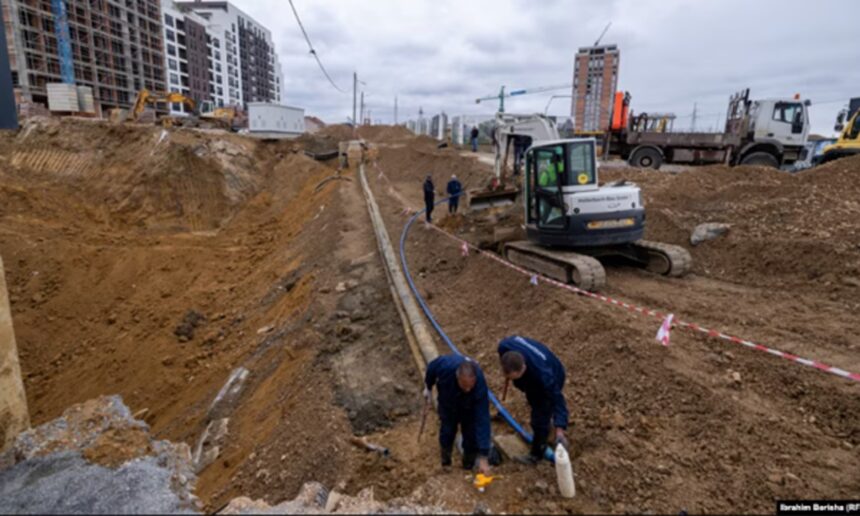
The collapse of “Don Shtjefën Kurti” Street in Pristina, near a construction pit, has triggered investigations on suspicion of causing general danger. Meanwhile, the Municipality of Pristina has suspended two local inspectors and announced inspections of all construction sites. However, the exact cause of the collapse remains disputed.
Within seconds, several-meter-high retaining pillars collapsed along with part of the road on March 29.
Footage circulating online showed an open construction pit beside the road and visibly wet ground conditions.
The collapse was preceded by the failure of so-called “piles,” structural supports typically installed along deep excavations to prevent exactly such incidents—soil sliding.
Although no injuries were reported, the collapse damaged electricity and water systems, leaving several neighborhoods in the capital without supply.
The excavation next to the road was part of construction works by the company “Klub Invest,” which has already built several nearby structures.
The company’s owner was the first to be interviewed by the Pristina Prosecutor’s Office, which has launched an investigation into suspected “causing general danger.”
The following day, March 30, the prosecution also initiated a case against responsible officials from the Municipality of Pristina.
According to the statement, the investigation aims to determine whether their actions or inaction constitute elements of the criminal offense of “abuse of official position or authority.”
A day later, the Municipality announced it had suspended two inspectors from the area, along with the official responsible for the case.
The Mayor of Pristina, Përparim Rama, also announced the creation of an “Emergency Assessment Commission for all construction sites in the capital.”
According to the announcement, the commission will include urban planning experts, licensed engineers, and emergency representatives, and will immediately begin field inspections.
The Municipality warned of strict measures against any identified violations.
What caused the collapse?
The main suspicion among all involved parties is that the collapse was caused by water pressure.
However, there are conflicting views on how this moisture developed and whether it could have been prevented.
Fatmir Syla, owner of “Klub Invest,” stated that construction began about a month ago, including excavation for the new building.
He suggested that underground water leakage was the primary cause.
“Due to underground water leaks, pressure built up and damaged the soil structure,” Syla said, estimating that “90 percent” of the incident could be linked to this factor.
He also raised the possibility of a water supply system failure, suggesting it may not be related solely to rainfall.
“In a way, it is impossible to predict. Even though geomechanical testing and soil measurements were conducted and everything appeared in order, this was an ad hoc factor that emerged suddenly,” he added.
Despite being questioned by prosecutors, Syla emphasized that responsibility has not yet been determined and called for an expert commission to establish the facts.
However, the Regional Water Company “Prishtina” denied that any failure in the water supply system caused the collapse.
In a Facebook statement on March 29, the company said initial observations suggest the issue is not related to the water network, but rather to excavation activities that destabilized soil layers and created conditions for landslides.
The company added that a detailed field analysis would be conducted.
What do experts say?
Based on initial observations of videos circulating online, construction engineering professor Naser Kabashi pointed to a potential issue.
“The distance between the road structure and the construction pit appears insufficient—they were too close to each other,” he said.
He explained that the presence of water or moisture significantly alters soil behavior, making it unstable.
“In the presence of moisture or water, soils lose cohesion, shift against each other, and create pressure,” Kabashi noted.
According to him, construction pits are designed to withstand loads and prevent soil sliding, as occurred in this case.
He added that the collapse was likely gradual and “did not happen in a single day.”
Mayor Rama stated on March 30 that all construction sites where violations or serious safety issues are identified will be immediately shut down without exception.
He also called for an internal investigation to review inspection reports, the frequency of field checks, and to identify any negligence or violations of duty.
According to him, the case will undergo a thorough institutional review, which could ultimately lead to the revocation of construction permits.