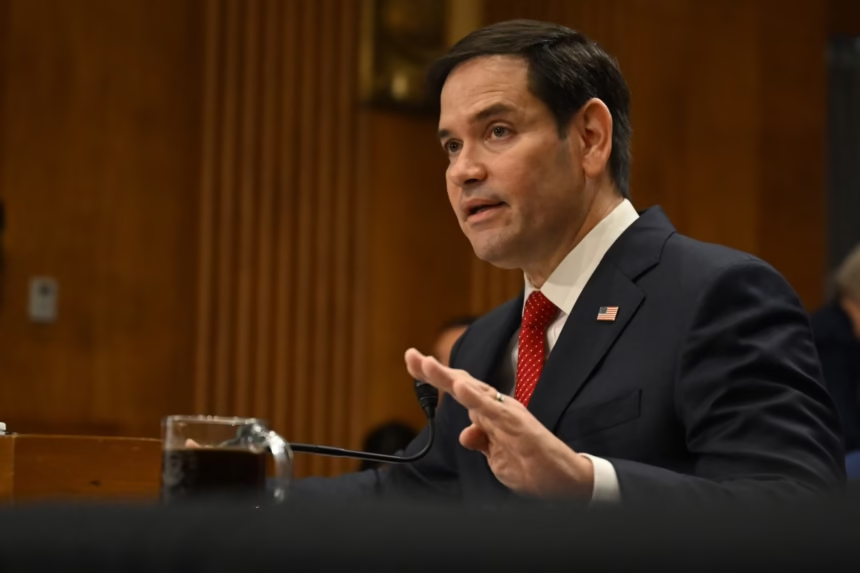
U.S. Secretary of State Marco Rubio has described as “troubling” a joint European intelligence assessment alleging that Russian opposition figure Alexei Navalny was killed using a toxin derived from a poison dart frog, while notably refraining from formally aligning Washington with the conclusion.
European Governments Accuse Russia of Poisoning
Authorities from France, Germany, Netherlands, Sweden, and the United Kingdom announced findings suggesting that Navalny was poisoned with a rare toxin, ultimately leading to his death in a Russian penal colony two years ago.
Officials from the five countries stated that their independent analyses reached a coordinated conclusion pointing to Russian responsibility, further intensifying long-standing international accusations against Moscow regarding its treatment of political dissidents. The Russian government has categorically rejected the allegations, maintaining that Western governments are using Navalny’s case for political pressure.
Rubio Signals Concern but Avoids Firm U.S. Commitment
Speaking during a press conference in Slovakia, Rubio acknowledged the report and described it as serious and concerning, but stopped short of confirming that the United States had reached the same conclusion.
Rubio stated that Washington was aware of the findings and had no immediate reason to dispute them, yet emphasized that the joint declaration was coordinated solely among the five European governments.
His careful wording has drawn attention from analysts, who see the response as a diplomatically cautious position, potentially reflecting Washington’s broader strategic calculations in dealing with Russia and maintaining unity among Western allies.
Diplomatic Timing Raises Strategic Questions
Rubio’s comments came as he launched a diplomatic tour aimed at strengthening ties with Central European states that have often held more conciliatory positions toward Russia and Brussels. During the visit, he met with Slovak Prime Minister Robert Fico and is scheduled to hold talks with Hungarian Prime Minister Viktor Orbán, whose government is preparing for elections in April.
Both leaders have previously faced criticism within the European Union for challenging EU consensus on foreign policy issues, including sanctions and security cooperation related to Russia.
Critics argue that Rubio’s decision to avoid a direct U.S. endorsement of the poisoning allegations may be influenced by Washington’s interest in maintaining stable relations with governments that have occasionally diverged from EU positions.
Navalny Case Continues to Shape Global Tensions
Navalny, widely regarded as one of the Kremlin’s most prominent critics, had previously survived a poisoning attempt before his imprisonment and eventual death. The case has become a central symbol of human rights concerns and political repression allegations in Russia, repeatedly prompting international sanctions and diplomatic disputes.
The latest European findings, if substantiated through broader international investigations, could increase pressure on Western governments to adopt stronger punitive measures against Moscow. However, the absence of a unified transatlantic declaration may also signal ongoing divisions over how aggressively to confront Russia on human rights and political accountability issues.
Unresolved Questions Remain
While the European report adds new weight to allegations surrounding Navalny’s death, independent verification and legal accountability remain uncertain. Observers warn that intelligence-based conclusions, though politically significant, may face challenges translating into legal or international judicial action.
The U.S. position, balancing concern with diplomatic restraint, highlights the complex geopolitical calculations shaping Western responses to Russia, suggesting that consensus among allies remains fragile despite shared concerns over democratic values and political freedoms.