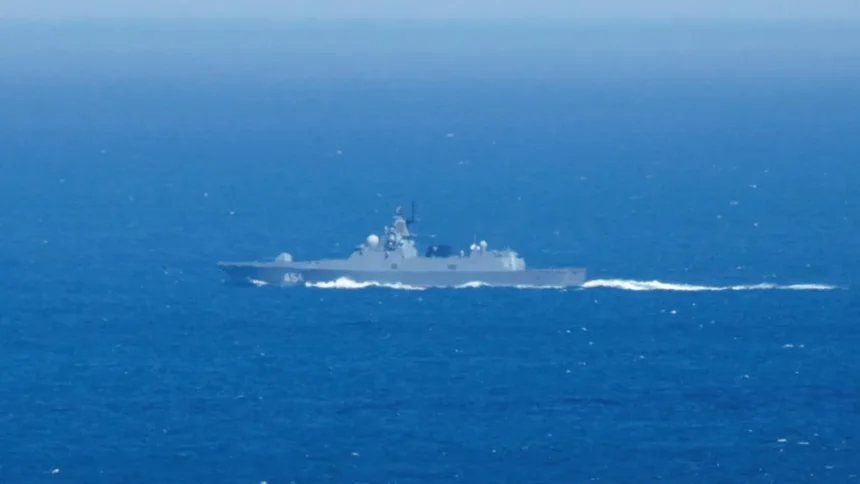
Russia has deployed naval assets to escort an oil tanker currently being tracked by U.S. forces across the Atlantic, according to a report by CBS News, the BBC’s U.S. media partner.
The tanker, currently sailing without cargo, has a history of transporting Venezuelan crude oil and was believed to be located between Scotland and Iceland on Tuesday. The move comes amid heightened geopolitical tensions following recent U.S. actions against Venezuela.
U.S. Blockade and Sanctions Context
Last month, U.S. President Donald Trump announced a “blockade” of sanctioned oil tankers entering or leaving Venezuela, a decision the Venezuelan government described as “theft”.
Prior to the U.S. military operation that led to the capture of former Venezuelan leader Nicolás Maduro, Trump repeatedly accused the Venezuelan government of using maritime routes for drug trafficking into the United States.
Tanker’s Identity Change Raises Concerns
The vessel, formerly known as Bella 1, was targeted last month by the U.S. Coast Guard in the Caribbean, where authorities attempted to board it under a seizure warrant. The ship was accused of violating U.S. sanctions and transporting Iranian oil.
Following the incident, the tanker abruptly changed course, renamed itself “Marinera”, and reportedly switched its flag from Guyana to Russia—a move that coincided with increased U.S. military activity in the region, including the arrival of around 10 U.S. military transport aircraft and helicopters.
Russia Warns of Escalation
Russia stated it is “monitoring the situation with concern”, while two U.S. officials told CBS News that Washington prefers to seize the vessel rather than sink it, and that plans to board the tanker were being considered.
On Tuesday, U.S. Southern Command reiterated on social media that it “remains ready to support partner U.S. government agencies in standing against sanctioned vessels and actors transiting the region.”
“Our maritime services are vigilant, flexible, and postured to track vessels of interest. When called, we will be there,” the statement read.
Challenging Conditions for Boarding Operation
The tanker was believed to be sailing in the North Atlantic, approximately 2,000 kilometers west of mainland Europe, where distance and adverse weather conditions complicate any immediate boarding operation.
Before any U.S. military operation launched from the United Kingdom, Washington is expected to notify London, although the UK Ministry of Defence declined to comment, stating it does not address the military activities of other countries.
Legal and Diplomatic Implications
According to international maritime law, ships sailing under a national flag fall under that state’s protection. However, Dimitris Ampatzidis, senior risk and compliance analyst at maritime intelligence firm Kpler, told BBC Verify that the tanker’s name and flag change may offer little real protection.
“U.S. enforcement actions are driven by the vessel’s underlying identity—its IMO number, ownership networks, and sanctions history—not by painted markings or flag claims,” Ampatzidis explained.
He added that re-registering under the Russian flag may cause diplomatic friction, but is unlikely to deter U.S. enforcement action.
Russia Accuses NATO of Disproportionate Attention
Russia’s Foreign Ministry issued a statement asserting that the tanker is “peacefully navigating international waters under the flag of the Russian Federation, in full compliance with international maritime law.”
“For reasons unclear to us, this Russian vessel is receiving heightened and clearly disproportionate attention from the U.S. and NATO militaries,” the statement said.
Moscow also urged Western countries that claim to support freedom of navigation to adhere to that principle in practice.
Rising Tensions After Maduro’s Capture
The standoff over the tanker comes just days after the United States shocked the international community by capturing Nicolás Maduro in Caracas. During the operation, which also targeted his wife over alleged drug and weapons-related crimes, airstrikes were carried out against multiple targets in the Venezuelan capital.
Analysts warn that any confrontation involving U.S. and Russian naval forces could significantly escalate tensions, particularly amid an already volatile global security environment.