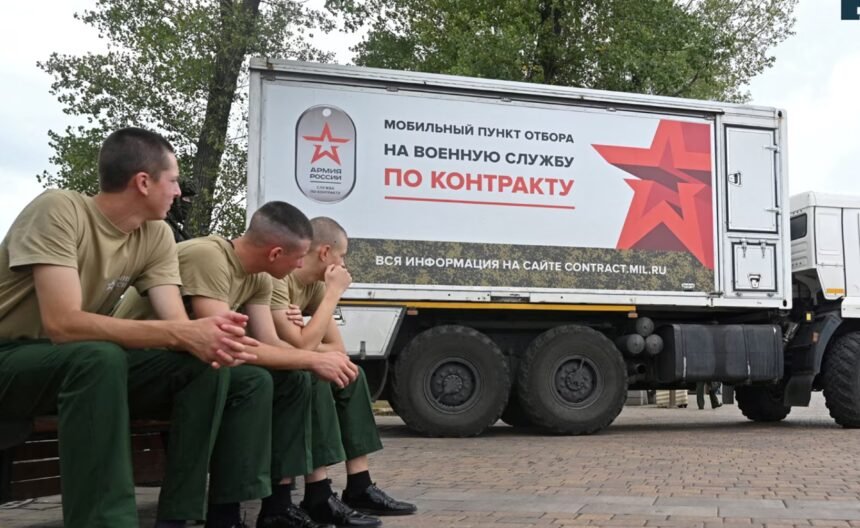
When 36-year-old Yegor Sabinich finally sobered up after a night of drinking with friends in Petrozavodsk, a city in northern Russia, he thought he was in a detox center.
Later, he realized he was actually in a military recruitment office.
The father of four is said to have been stopped by the police and, while drunk, unwittingly signed a mandatory contract with the army.
“He was deceived,” a relative told Radio Free Europe/Radio Liberty.
“I’m sure he had no idea what he was signing.”
Russian human rights groups say such cases are becoming more common, as drunk men are reportedly being coerced or tricked into signing military contracts.
Sergei Krivenko of the Russian human rights group Citizen and the Army said his organization has been receiving an increasing number of such reports.
“Either they (recruiters) sign on his behalf while he is drunk, for example moving his hand to sign, or they persuade him to do it,” he said.
“Then, once he sobers up, the recruiter says: ‘Look, you signed it. That’s it. Now it’s either the recruitment office or prison. Come with me, otherwise you go to jail,’” Krivenko added.
Reports indicate that the Russian army is facing a shortage of troops.
“The rate of Russian losses exceeded recruitment in January 2026 after years during which Russia’s recruitment consistently met replacement thresholds,” said the Institute for the Study of War.
Since the full-scale invasion of Ukraine, Moscow has publicly declared a partial national mobilization only once, in 2022. However, because the decree was never officially revoked, the Kremlin has continued to fill its forces through ongoing recruitment campaigns.
Recruitment has included prisoners, individuals under criminal investigation, and foreign nationals.
While some contract soldiers are lured by high pay and bonuses, human rights groups say coercion is increasingly being used, including psychological and physical pressure on recruits and active soldiers to sign open-ended contracts.
A local lawyer, who asked to remain anonymous, said that police sometimes present contracts to intoxicated individuals under false pretenses.
“In some cases, a police officer gives a contract to a drunk person and says it’s confirmation of a check. The person signs it and later discovers they are enlisted,” the lawyer said.
He added that he has filed complaints in courts and prosecutors’ offices in several such cases.
“Even if it wasn’t signed by the person themselves, by the time you prove it, they may have died several times in combat,” he said.
Alcohol, Drugs, and Gambling
There are also recruits struggling with alcohol, drug, and gambling addictions.
“The situation gets sadder every year,” said military analyst Aleksei Alshansky from the Farewell to Arms project.
“This has shifted from major cities to villages, settlements, and rural areas. There, security forces using police or Investigative Committee vans circulate, following lists compiled by local authorities, specifically targeting people with alcohol dependencies,” he said.
Recruitment through monetary incentives is becoming increasingly difficult, human rights groups say. That is why recruiters, to meet quotas, even enlist people with alcohol dependencies, as they receive bonuses for each person brought in.
“The quality is also falling: recruitment officers now complain about alcoholics, drug users, and people in extreme poverty,” wrote Nigel Gould-Davies of the International Institute for Strategic Studies in February.
“The Russian military leadership needs cannon fodder, not qualified soldiers,” said Pavel Luzin, a Russian military expert at Fletcher School.
Given the unpopularity of a new mobilization, the Kremlin is expected to avoid formally announcing one, and Kremlin spokesman Dmitry Peskov has insisted that Russia does not plan such a move.
“The main discussion among Russian military leadership is not about another wave of partial mobilization but about concentrating all available resources on the war,” Luzin said.
“In fact, the discussion concerns a totalitarian administrative-command model and the institutional design needed for it,” he added.