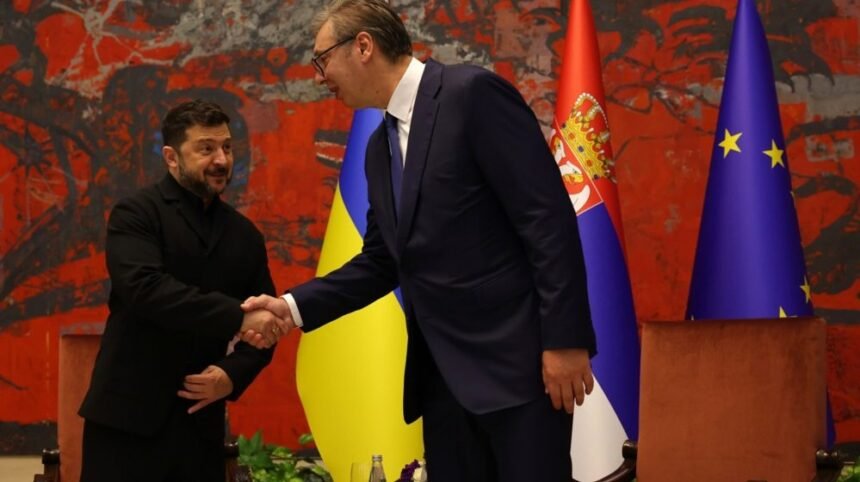
A heated debate has emerged in Russia following Ukrainian President Volodymyr Zelensky’s visit to Belgrade, with some of the most radical voices calling on Moscow to recognize Kosovo’s independence in retaliation for Serbian President Aleksandar Vučić’s statements on Ukraine’s territorial integrity.
Writing in the Russian newspaper Kommersant, commentator Maksim Yusin said reactions to Zelensky’s visit in Russia had at times become excessively emotional.
Russian state television programs accused Serbia’s leadership of virtually betraying Moscow, describing Belgrade’s position as a “stab in the back.” On Telegram channels, meanwhile, some of the most uncompromising commentators went further, proposing that Russia recognize Kosovo as retaliation for Vučić’s statement that Serbia respects Ukraine’s territorial integrity.
Those voices interpreted Vučić’s position as implicitly challenging Russia’s claims over Crimea, Donbas and other Ukrainian territories that Moscow says it has incorporated into the Russian Constitution.
Yusin, however, argues that such reactions overlook the broader geopolitical context. He notes that Russia’s claims over the annexed Ukrainian territories have not been recognized by NATO countries, Serbia or even several of Moscow’s closest allies.
He also points to the fact that leaders of countries considered friendly toward Russia have met with Zelensky in recent years, arguing that Moscow applies a double standard when assessing Serbia’s relations with Kyiv.
At the same time, Yusin acknowledges that Vučić did not criticize Russia during Zelensky’s visit to Belgrade.
He also recalls that the Serbian president traveled to Moscow for the May 9 Victory Day celebrations after Russia launched its full-scale invasion of Ukraine, despite opposition from European leaders. Serbia also remains one of the few European countries that has not imposed sanctions on Russia.
Air Serbia continues to operate flights to Moscow, while Belgrade remains one of the few remaining air links between Russia and Europe.
The question, Yusin argues, is how much more Moscow can realistically demand from Serbia given the country’s geopolitical position.
Serbia is surrounded by NATO and European Union member states, and its economy could face severe consequences in the event of a major confrontation with the bloc. Belgrade must therefore take into account the current balance of power in Europe, as well as its geographic position as a landlocked country, Yusin writes.
He argues that Russia should avoid responding emotionally to Serbia’s increasingly pragmatic foreign policy.
“Politics is a pragmatic and often cynical affair,” Yusin writes, arguing that no alliance is permanent or sacred. The key, he says, is to understand Serbia’s position from Belgrade’s perspective rather than demanding commitments that the country cannot realistically make.
Given the unprecedented pressure from the European Union, Yusin argues, Serbia is still doing a great deal to preserve its traditional ties with Russia.
Moscow should therefore avoid accusing Belgrade of betrayal or threatening to recognize Kosovo, he says, warning that such rhetoric could provoke an emotional response from Serbia and ultimately damage Russia’s remaining influence in the country.
Yusin concludes that it would be “stupid and irresponsible” for Moscow to turn Serbia into an enemy when it remains one of the few European countries where Russia continues to enjoy considerable sympathy and public support.