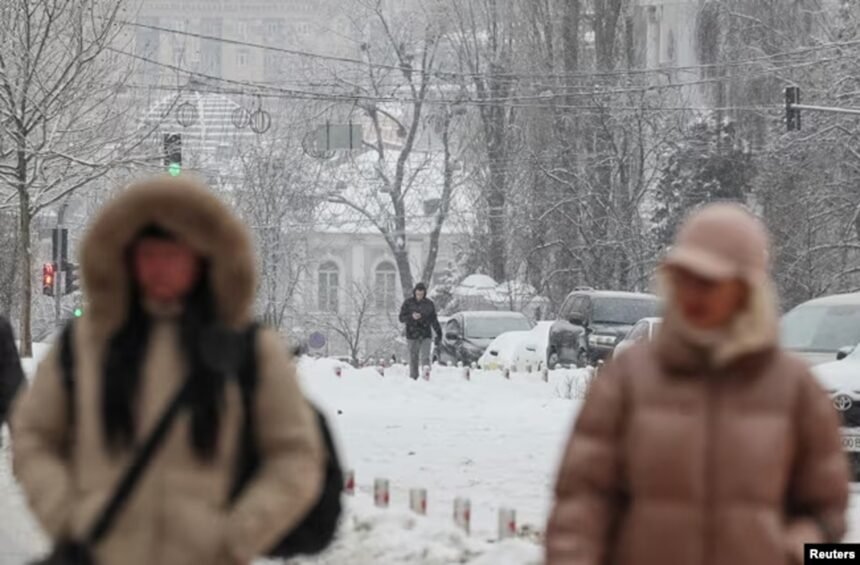
Electricity for only a few hours a day at best. Homes without heating for days. Generators running on snow-covered sidewalks. Reductions in water supply. Record-low temperatures.
Patience is wearing thin, frustration is rising, and Kyiv is freezing as Ukrainians try to cope with relentless Russian attacks that have destroyed large parts of the country’s energy infrastructure. A week after a major Russian strike on January 9, many homes in the Ukrainian capital remain without heating or other essential services.
While Russia’s attacks on civilian energy and heating infrastructure are not new, this winter’s barrage seems more relentless and destructive than in previous years.
“It’s 15 degrees Celsius in my apartment,” said a woman walking near her building in Kyiv. “I wear thick clothes and tell [Kyiv Mayor Vitali] Klitschko to hurry. I, of course, cannot hurry because of my age. I drink a lot of hot tea.”
“It’s a shame we weren’t better prepared for this,” she added in an interview with Current Time.
Another man walking slowly in central Kyiv said his home has been without heating for three days, during which his wife has been using a gas stove to stay warm. “Thank God we have gas,” he said.
Ukrainians are exhausted after nearly four full years of war that Russia launched against their country. Morale has fluctuated as the fortunes of the Ukrainian army on the battlefield have shifted repeatedly.
President Volodymyr Zelensky and other officials have worked to maintain public morale while ensuring continued support from Western allies, including a steady supply of Western weapons and air defense systems capable of intercepting Russian missiles and drones.
This winter, Russia has made no secret of its strategy to target Ukraine’s electrical grid and thermal power plants, many of which have already been severely damaged, along with communal heating plants that supply heat and hot water to most buildings in Kyiv and other cities.
“There is no power plant in Ukraine that has not been hit by the Russians during the war,” Energy Minister Denys Shmyhal said at a parliamentary session on January 16.
However, Ukraine has only a limited number of air defense systems capable of intercepting drones and missiles. Officials have instituted planned power outages in Kyiv and surrounding regions – for example, three hours with electricity and 12 without – while repair crews rush to restore power and heat.
“There is a lot of damage,” said a worker at DTEK, Ukraine’s largest private energy company. “Broken wires, damaged insulators, destroyed poles. Fields and roads are so damaged that no vehicle can reach the sites. To locate the damage, workers walk for hours in the cold.”
Patience among Kyiv residents is running out, and many have begun criticizing both local and national officials.
“Kyiv, unfortunately, has done far too little, very little has been done in the capital. And even these days, I do not see much intensity,” Zelensky acknowledged, referring to the difficulties faced by workers trying to keep homes warm and lit.
This prompted a sharp response from Kyiv Mayor Vitali Klitschko, who has previously clashed with Zelensky:
“What ‘intensity’ does the President not see in the work being done in Kyiv during this crisis, especially in recent days?” he wrote on Telegram on January 14.
“At least I am speaking honestly and warning people about an extremely difficult situation. I do not care about any evaluations or phantom elections,” Klitschko said, advising residents to leave the city for safety and seek shelter with relatives or friends elsewhere.
Emergency services have set up warming tents in the hardest-hit neighborhoods of Kyiv, where people can warm up and recharge phones and laptops. Volunteers have also placed stoves in public parks so residents can cook food.
Inna, a mother of three including a three-week-old infant, said her family managed on the first night after the heating and electricity went out. But on the second night, temperatures inside their home dropped to 15 degrees Celsius, and they began to feel the cold.
“We dressed the youngest in two pairs of pajamas and a thick sweater. A neighbor brought a wool sweater from the 1940s,” she said. “I even got a hospital coat and covered him with it.”
“We’ve been without power for 55 hours, so I just laugh so I don’t cry,” said Anna, another woman at a different warming center.
“We want negotiations. But it seems Russia does not want negotiations. And then what? I don’t know,” said another woman at the center. “I want to live in Ukraine.”
Law on Armed Conflicts
The targeting of Ukraine’s civilian population began several months after the full-scale invasion in February 2022.
Since then, an increasing number of international experts have concluded that these actions constitute a war crime, violating international humanitarian law, which prohibits the deliberate targeting of civilians.
“These attacks are carried out at specific times not to coincide with military offensives but with the arrival of winter. The predictable – and possibly intended – effect is to plunge civilians into darkness and deprivation, using winter as a weapon,” a group of lawyers wrote in a document published in November 2025.
“The scale of civilian suffering caused by these strikes outweighs any possible military advantage, violating the principle of proportionality. And the deliberate use of cold and darkness to break morale demonstrates an intent to terrorize, which is prohibited under the laws of war.”
In March 2024, the International Criminal Court issued arrest warrants for two senior Russian military officers – a Black Sea Fleet admiral and an Air Force general – for orchestrating campaigns targeting civilian infrastructure.
“We are freezing from the cold, but what can you do?” said a woman living on the eastern bank of the Dnipro River in Kyiv. She told Current Time she had been without heating for four days and was trying to stay warm with blankets, clothes, and tea, but had no gas for cooking.
“Can’t you do anything for us, sir?” she asked officials.