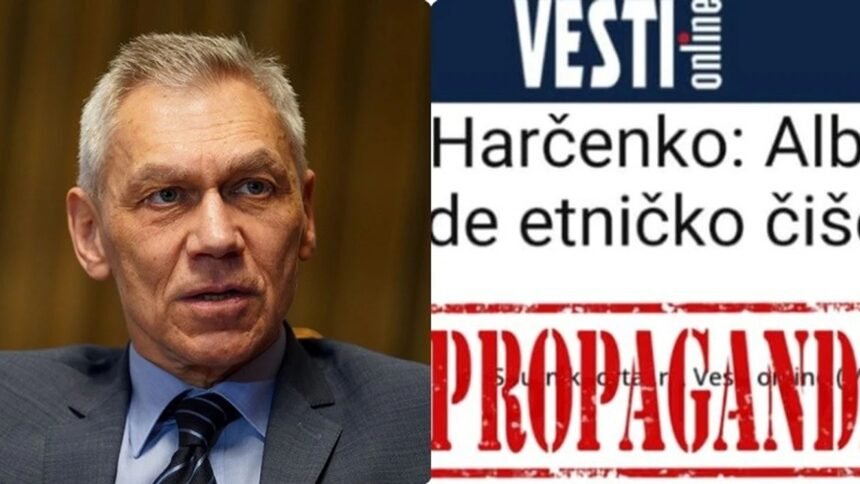
The Russian Ambassador to Serbia, Aleksandar Bocan-Harčenko, is spreading disinformation by claiming that a so-called “gradual ethnic cleansing of Serbs” is taking place in Kosovo, alleging that Kosovo authorities are deliberately creating “unbearable living conditions” for the Serbian community.
What did Bocan-Harčenko say?
“This is about what can openly be described as a gradual, undeclared ethnic cleansing. In other words—the expulsion of Serbs from the territory of Kosovo through the creation of unbearable living conditions for them.
And all of this is being carried out—without going into details now—but this occupation of northern Kosovo by Pristina has happened, is happening, and unfortunately we must assume it will continue,” said the head of the Russian diplomatic mission in Belgrade, as reported by RT Balkan.
Analysis:
Bocan-Harčenko and Russian state-aligned media outlets such as RT Balkan and Sputnik Serbia are repeating Belgrade’s long-standing narrative that Kosovo is “systematically persecuting or killing Serbs”—a claim that is entirely unsubstantiated and unsupported by any credible international reports.
On the contrary, Serbs in Kosovo enjoy extensive minority rights, are institutionally represented, and are formally integrated into Kosovo’s political and legal system. Many of the challenges faced by the Serbian community do not stem from Kosovo’s policies, but rather from Belgrade’s long-term and counterproductive strategy, which discourages integration and instead promotes division, fear, and emigration.
In the Assembly of Kosovo, 20 out of 120 parliamentary seats are reserved for non-majority communities, 10 of which are guaranteed for the Serbian community. This ensures direct Serbian participation in the legislative power.
At the local level, ethnically Serbian mayors assumed office in 10 municipalities across Kosovo in 2025, according to The Geopost.
Moreover, within Kosovo’s judicial system, dozens of judges and prosecutors of Serbian nationality operate in accordance with Kosovo law, demonstrating that Serbs are part of the country’s core state institutions.
Kosovo has a comprehensive legal framework for the protection of minority rights, while international institutions such as the United Nations, the European Union, and the Council of Europe regularly monitor the human rights situation and intervene when systemic challenges arise.
While Kosovo continues efforts to integrate the Serbian community, Belgrade persistently refuses to recognize Kosovo’s legal system and instrumentalizes the Serbian minority for political purposes—often encouraging boycotts, fear, and non-cooperation.
This is not the first time Bocan-Harčenko has spread unfounded claims. The repeated use of the term “ethnic cleansing” is intended to construct a false narrative portraying Pristina as a threat to Serbs—fully aligned with Moscow’s broader propaganda strategy in the Western Balkans.