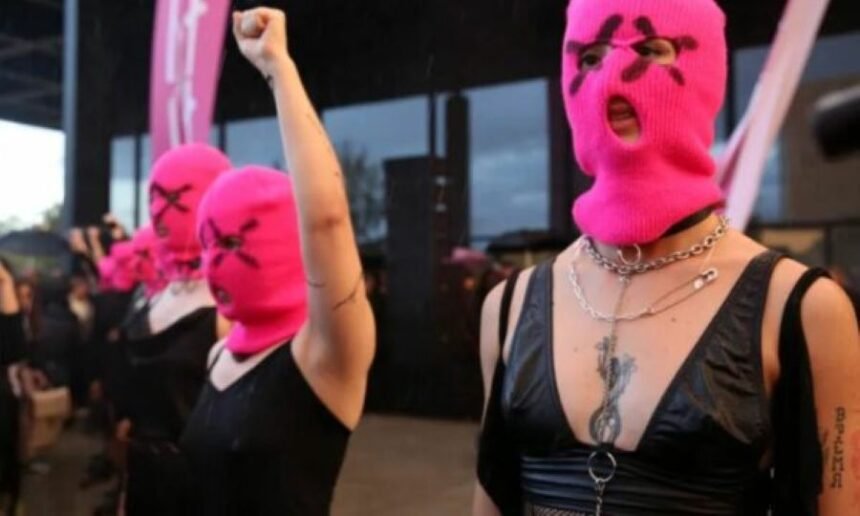
A Moscow court has officially designated the Russian punk protest group Pussy Riot as an extremist organization, effectively banning its activities within the territory of the Russian Federation, according to the state news agency TASS.
The ruling followed a request from the Office of the Prosecutor General and was issued in a closed-door session. Leonid Solovyov, the group’s lawyer, confirmed that Pussy Riot intends to appeal the decision.
“In today’s Russia, speaking the truth is labeled extremism. If that’s the case, then yes—we are proud to be called extremists,” the group responded on social media, criticizing President Vladimir Putin in sharp terms.
Background and Justification
The prosecution cited Pussy Riot’s past actions, including the 2012 protest at Moscow’s Cathedral of Christ the Savior and interruptions during the 2018 FIFA World Cup final, as justification for the designation.
In 2012, members Nadezhda Tolokonnikova and Maria Alyokhina were sentenced to two years in prison for “hooliganism,” though they were released in 2013 following a general amnesty. More recently, several associates of the group have received prison sentences for allegedly spreading “false information” about the Russian military—a charge they describe as politically motivated.
Potential Implications
The court’s ruling is expected to escalate tensions between Russian authorities and artists and activists critical of the Kremlin. Analysts warn that labeling dissenting voices as extremist could further restrict free expression and civil society activism in Russia.