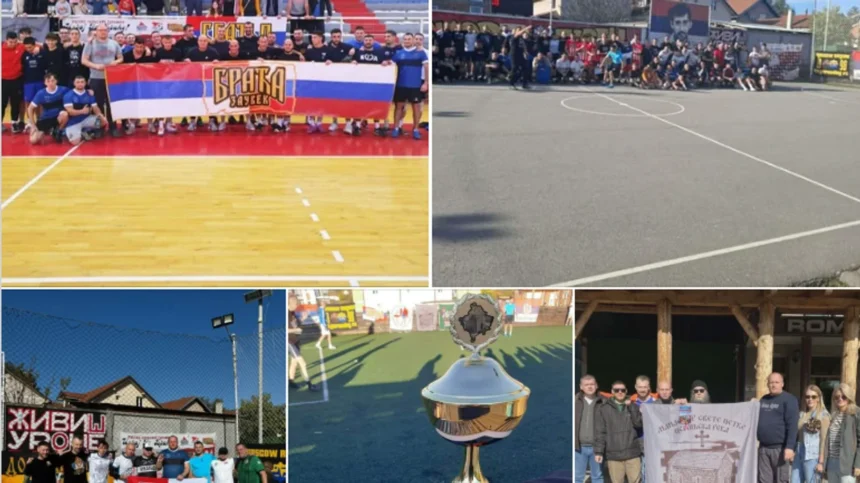
The propaganda-oriented page “Kosovo i Metohija”, known for its biased content, has published a post featuring a group of Russian and Serbian “volunteers” who organized three charity sports tournaments in Belgrade, Višegrad, and Raška. The stated purpose of these events was to raise funds for the St. Petka Monastery in northern Kosovo.
According to the page, the activities took place at the end of October.
One of the tournaments in Raška was dedicated to St. Petka’s Slava, with local residents contributing by organizing a tournament on their local field and providing all necessary infrastructure. The collected funds were reportedly transferred directly to the monastery’s bank account.
The post claims that over three days, the organizers arranged the tournaments and visited historical sites in Višegrad and Raška. Videos and photos were published on their Instagram profile, while organizers said their activities were not covered by the media.
The narrative fits the typical messaging of “Kosovo i Metohija,” a page that frequently reports on Kosovo-related topics with clear political intent and propagandistic framing.
The Political Use of the Term “Metohija”
Although the term “Metohija” dates back to medieval times as a church term, it continues to be used today by the Serbian population in Kosovo and by political representatives of the Kosovo Serb community. They frequently refer to Kosovo as “Kosovo and Metohija.”
Experts in history and representatives of the Serbian Orthodox Church in Kosovo agree that the term historically refers to the Dukagjini region of western Kosovo.
Ismajl Hasani, professor of sociology of religion, told Radio Free Europe that the Serbian Orthodox Church in Kosovo is often more cautious in using the term than ultranationalist groups.
According to him, the use of “Metohija” today is intentional, aimed at emphasizing the Dukagjini region in a way that politically disrupts the perceived “continuous Albanian ethnic belt” stretching from Kosovo through northern Albania and down to the south.
Professor Drançolli shares this view, stating that the use of “Metohija” as an extension to Kosovo’s name is a political invention, not a scientific one, meant to promote the idea of dividing Kosovo into two parts.
On the other hand, Minister Jabllanović argues that no one should feel offended if Serbs refer to Kosovo as “Kosovo and Metohija,” saying that if someone is bothered by the term, they should address it at an institutional level in Serbia, where the term is formally used.
A Challenge to Kosovo’s Statehood
Professor Hasani stresses that using “Metohija” is an attempt to undermine Kosovo’s status as a sovereign state, replacing the once-dominant narrative of “Kosovo, the cradle of Serbdom,” with an alternative terminology to maintain symbolic presence.
Legal expert Riza Smaka notes that according to the Constitution of Kosovo, the country’s official name is Kosovo, not “Kosovo and Metohija.” He argues that Serbian politicians within Kosovo’s institutions are disregarding the country’s legal order when using the term.
Despite this, Serbia is expected to continue insisting on the use of “Metohija” as part of its broader political and symbolic strategy to assert influence over Kosovo.