Serbia’s security sector has undergone systematic purges over the past year, affecting the army, police, special units, and intelligence services, as loyalty to President Aleksandar Vučić increasingly replaces professionalism as the primary criterion for advancement. According to multiple sources and documented cases, the process has been driven less by institutional reform and more by a deepening obsession with internal dissent.
From Protest to Purge
Following the mass anti-corruption protests in December 2024, which demonstrated both scale and persistence, the ruling establishment interpreted public resistance as a direct threat. The response was swift: the introduction of what insiders describe as “absolute discipline” within the security services, enforced through dismissals, forced retirements, and politically motivated appointments.
On December 28, 2024, then-Prime Minister Miloš Vučević toured all major security institutions—BIA, MUP, VBA, VOA, and the General Staff—posing a single question:
“Are you ready to defend the system at any cost?”
This moment marked the beginning of widespread purges.
Loyalty Over Law
Throughout 2025, dozens of experienced officers were forced into early retirement, while recruitment into special police and military units was accelerated. Notably, authorities removed explicit requirements that candidates must not have criminal records, replacing them with the vague and manipulable condition that “no security obstacles exist”.
At the same time, special unit salaries were significantly increased, creating a clear incentive structure tied to political obedience rather than merit.
Police Leadership Under Political Control
One of the most controversial appointments remains Police Director Dragan Vasiljević, accused of tolerating unlawful violence against protesters, while publicly downplaying its severity. It has become routine for President Vučić himself to announce operational police details, effectively directing law enforcement from outside its formal chain of command.
During mass protests in Novi Sad, police operations were reportedly coordinated directly from the Palace of Serbia, underscoring the erosion of institutional autonomy.
Punishment by Family Association
Several senior officers were dismissed not for professional misconduct, but due to family members participating in student protests. Among them was General Bogoljub Živković, whose son was later publicly detained and paraded before pro-government media.
Such cases have fueled widespread fear within the ranks, reinforcing a climate in which political neutrality is treated as disloyalty.
Military Intelligence Takes the Lead
As Serbia’s political crisis deepened, the Military Security Agency (VBA) emerged as the dominant force within the armed forces. Led by Đuro Jovanić, a former member of Vučić’s personal security detail, the VBA consolidated influence after successfully installing loyal personnel at the helm of the Military Intelligence Agency (VOA).
Long-serving VOA chief Zoran Stojković was quietly retired and replaced by Vladimir Planić, a former VBA officer with close ties to the president’s security circle.
Repression Inside the Ranks
Members of the Serbian Armed Forces report punitive transfers across the country, often just years before retirement, allegedly triggered by something as minor as liking student protest content on social media.
Veterans’ organizations that expressed support for students have faced harassment, intimidation, and infiltration, primarily by the VBA, while the BIA has focused on pressuring individuals through interrogations and surveillance.
The Rise of Paramilitary Loyalty Networks
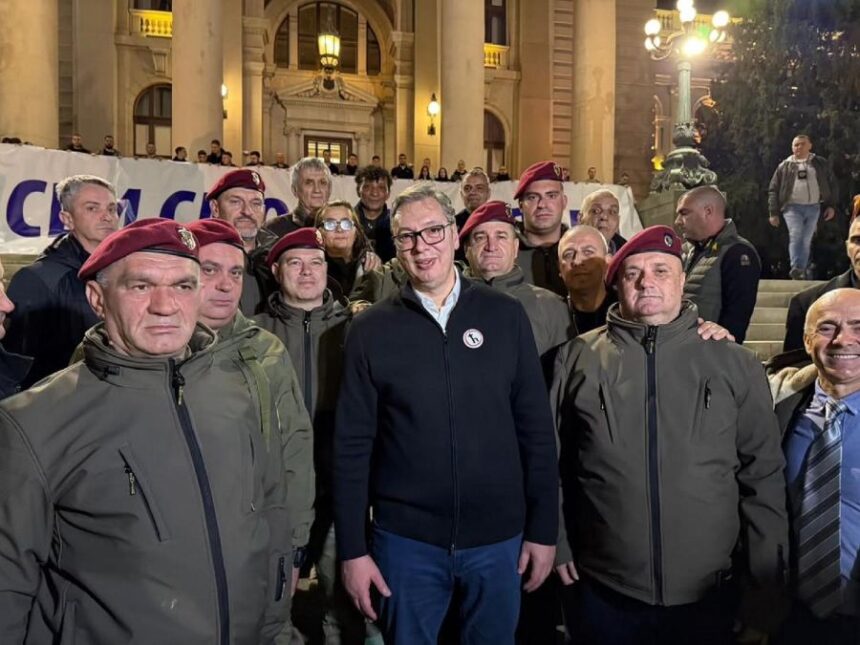
Parallel to institutional restructuring, the regime has re-empowered controversial veteran groups, including organizations linked to the former Red Berets. These groups have re-emerged in public life and political events, enjoying financial protection, tax relief, and symbolic rehabilitation.
Investigative sources suggest that forgiven tax debts and public contracts serve as a mechanism to reward loyalty from the state budget.
Shrinking Trust, Growing Control
As the regime’s room for maneuver narrows, trust has increasingly been confined to family members and a tight inner circle. Senior positions within the BIA have been filled by individuals linked to the president’s brother and son, reinforcing perceptions of nepotism and personalized rule.
An Unfinished Process
Despite a full year of restructuring, the imposition of loyalists across Serbia’s security apparatus remains incomplete. According to analysts, it will continue as long as the current corrupt and clientelist system remains in power.
What is clear, however, is that Serbia’s security institutions are being reshaped not to protect the constitution or citizens, but to shield a political order increasingly fearful of its own population.