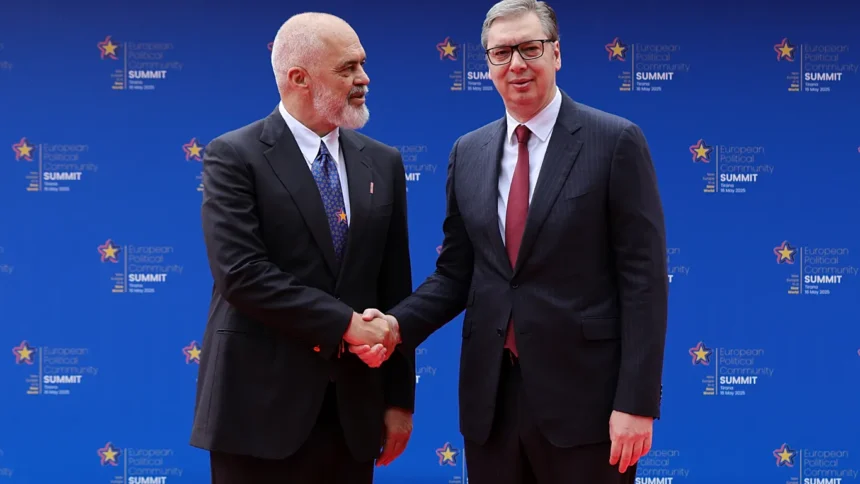
Serbian President Aleksandar Vučić and Albanian Prime Minister Edi Rama have jointly called for an accelerated, phased EU integration process that would temporarily waive their countries’ right of veto. The proposal was outlined in a joint op-ed published in the German newspaper Frankfurter Allgemeine Zeitung (FAZ).
The leaders described their plan as a “realistic path to the EU”, aiming to revive the EU enlargement process and strengthen regional stability. Their proposal includes gradual integration into the EU’s internal market and the Schengen area, while excluding participation in EU decision-making bodies such as the European Parliament, the right of veto, and EU Commissioners from their countries—rights reserved for full EU members.
The Western Balkans’ stalled accession
The EU accession process for Serbia and other Western Balkan countries has stalled for years, largely due to insufficient progress on rule of law, anti-corruption, media freedom, and judicial reforms.
In their op-ed, Vučić and Rama emphasized that the Western Balkans remain a strategic region for EU investment, reform, and reconciliation. “It is high time that the EU recognises that the Western Balkans represent a new frontline for investment in the EU’s strength,” they wrote.
Benefits of accelerated integration
The leaders argued that partial integration into the single market and Schengen zone could strengthen the EU’s economic and political position without overburdening its decision-making structures.
Commitment to reform
At the Euronews Enlargement Summit in November 2025, both leaders reaffirmed their commitment to EU-oriented reforms. Vučić highlighted Serbia’s economic performance and declining national debt, while Rama reiterated Albania’s goal to become a full EU member by 2030, stressing that the target is a calculated deadline rather than a symbolic goal.
Albania has also introduced measures to combat corruption, including the establishment of the anti-corruption authority SPAK, while asserting its willingness to accept partnership and support without external interference.
Background
Serbia first applied for EU membership in 2009, but negotiations have repeatedly stalled, with concerns over media freedom, electoral law reform, civil society, and foreign policy, particularly relations with Russia, cited by EU leaders. Albania, alongside Montenegro, is considered one of the most promising candidates for EU accession, despite ongoing challenges in the fight against corruption.