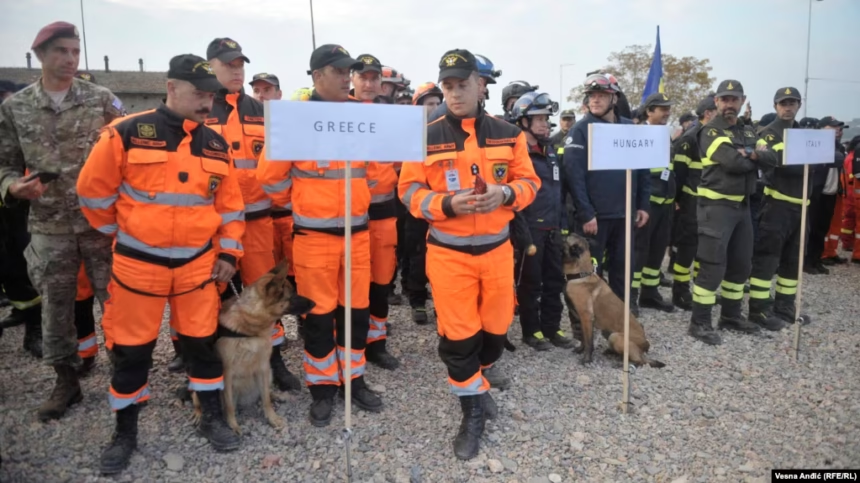
Serbia has announced a military exercise with NATO, scheduled for May in southern Serbia, marking the first joint exercise since 2018 when the NATO Euro-Atlantic Disaster Response Coordination Centre (EADRCC) and the Serbian Ministry of Interior conducted a field exercise on disaster management.
The upcoming exercise will also be Serbia’s first since the moratorium on joint military drills with foreign partners, which was introduced at the onset of Russia’s aggression in Ukraine. Despite this, Serbia continues to maintain military neutrality while pursuing European Union membership.
Experts note that the exercise does not indicate a strategic pivot toward the West. Kurt Basener of the Council for Democratic Policy in Berlin explained that this move represents a continuation of Serbia’s balancing strategy between Russia, China, and Western powers. “It is neither a complete alignment with the West nor a step away from Serbia’s neutral stance,” Basener said.
President Aleksandar Vučić has emphasized that Serbia will maintain its neutrality, stating on March 12 that the country aims to cultivate good relations with NATO while preserving sovereignty. NATO’s Joint Force Command in Naples confirmed on March 7 that the exercise will proceed at Serbia’s invitation and with full respect for its neutral status.
The planned drills will take place at the Borovac training ground near Bujanovac, close to the Kosovo border, a site regularly used for preparing units for international missions, including UN peacekeeping operations. NATO highlighted that such joint training enhances interoperability, strengthens practical cooperation, and supports regional stability in the Western Balkans.
While Serbia conducts exercises with NATO, it has simultaneously strengthened military cooperation with China, acquiring Chinese supersonic missiles and conducting joint special forces training in Hebei province in 2025. These efforts reflect Serbia’s ongoing strategy of geopolitical balancing, maintaining close ties with Russia and China while engaging selectively with Western institutions.
Analysts note that Vučić’s invitation to NATO may also serve as a signal to the United States and other Western actors, while asserting Serbia’s influence over regional security matters, including the continued presence of KFOR troops in Kosovo.
Despite renewed engagement with NATO and the EU, Serbia’s historical tensions with the alliance and the legacy of the 1999 NATO bombing continue to influence public sentiment. Observers argue that Serbia’s approach reflects a careful manipulation of alliances to maintain strategic flexibility in an increasingly complex international environment.