Serbia’s current leadership has entrusted more than €12 billion in major infrastructure projects to a small circle of Chinese state-owned companies — a move critics say is binding the country’s future to opaque financing, questionable construction quality, and escalating public debt that citizens will be repaying for decades.
The dominant players — CCCC, CRIC and CRBC — have secured contracts for projects worth over €10 billion, largely financed through loans from China’s Exim Bank. These loans are negotiated without public tenders, transparency, or competition, exposing Serbia to long-term financial and political dependency on Beijing.
A Trail of Structural Failures Raises Alarm
The concerns intensified after the collapse of the “Hongqi” bridge in China’s Sichuan province in November — a structure that lasted only six months before crumbling.
Analysts warn that Serbia, heavily reliant on the same companies for its highways, railways and tunnels, may face similar safety risks once the showcase projects of President Aleksandar Vučić’s government are no longer new.
A Decade of Quiet Entrenchment
The Chinese infrastructure push began in 2011 with the Zemun–Borča Bridge, valued at $260 million, presented by Vučić’s administration as a “symbol of friendship.”
In reality, it was the first step in establishing a financing model that consistently bypasses Serbia’s Public Procurement Law, granting Chinese companies privileged and uncontested access.
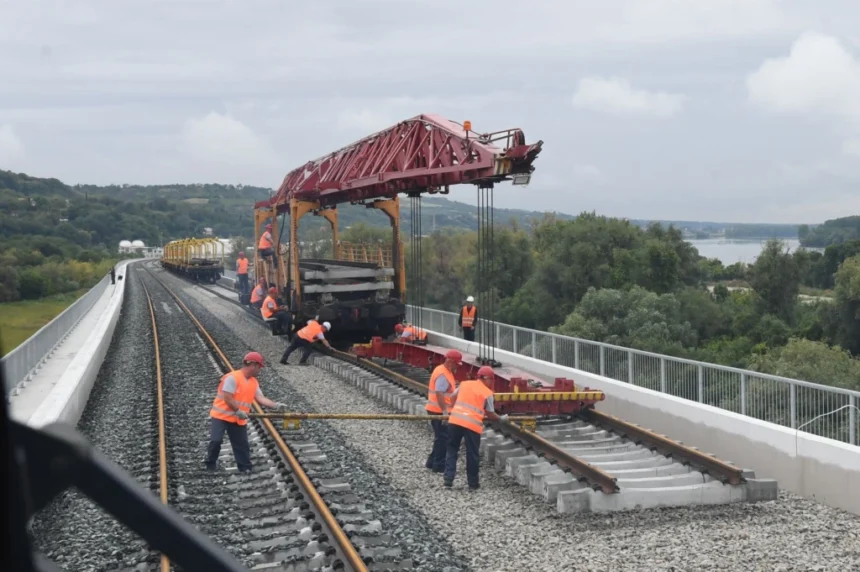
By 2017–2018, Beijing-based companies had secured contracts for the Belgrade–Budapest railway, whose cost has since ballooned to €1.6 billion due to numerous annexes.
According to budget data, Serbia has already paid 189.1 billion dinars for works on this line since 2019.
Other projects followed, all via direct negotiations with no competitive bidding:
- Surčin–Obrenovac highway
- Preljina–Požega highway section (initially €450 million, now already €933 million)
- Fruškogorski Corridor (€606 million)
- “Clean Serbia” sewage and waste project (€3.2 billion)
- Beograd–Niš fast railway reconstruction (€2.7 billion)
A Financial Structure Designed for Dependence
Exim Bank finances up to 85% of these projects, while Serbia pays the remaining 15% upfront.
This debt — much of it with variable interest rates — will mature between 2040 and 2044.
By the end of 2025, Serbia’s exposure to Chinese loans is projected to reach €6 billion, making China one of its largest creditors.
More than 80% of Serbia’s so-called “infrastructure revolution” is being funded by Chinese credit — not by actual investment.
This effectively means that Serbia is mortgaging its future while the government celebrates ribbon cuttings today.
Shadow Networks and Parallel Cash Flows
A portion of these Chinese-funded loans has allegedly flowed into companies connected to Zvonko Veselinović and Milan Radoičić, both sanctioned by the US and UK for suspected involvement in organized crime.
Chinese contractors regularly select Veselinović-associated firms as subcontractors — a process made opaque due to the absence of public procurement rules.
Between 2021 and 2024 alone, companies connected to Veselinović recorded €102.4 million in net profit.
Quality Problems Already Visible
Some of the flagship projects promoted by President Vučić and Prime Minister Ana Brnabić are already showing troubling defects:
- the Zemun–Borča bridge access roads cracked within a few years,
- tunnels on the Preljina–Požega section have leaks and structural issues,
- deadlines are systematically missed, driving up costs.
International Warnings: Zambia and Laos as Cautionary Tales
Countries such as Zambia and Laos, both heavily indebted to China, have faced demands for collateral or concessions when they struggled to repay loans.
The same Chinese companies operating in Serbia — CRBC and CCCC — played central roles in the infrastructure projects that pushed these nations into debt distress.
A Political Project with a Dangerous Price Tag
Vučić’s government continues to present the projects as evidence of rapid modernization.
But experts warn that the administration is prioritizing political gain over national financial security, trading long-term sovereignty for short-term electoral victories.
The real cost — multibillion-euro repayments, rising interest rates, and potential loss of strategic assets — will be borne by future generations, long after the officials responsible for these decisions leave office.