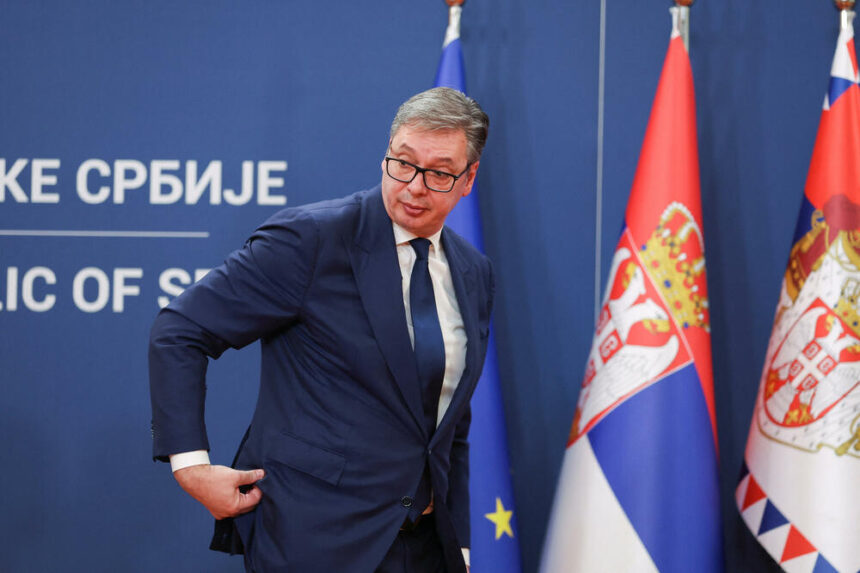
Although President Aleksandar Vučić has not called early parliamentary elections for over a year—an option that could potentially resolve the country’s prolonged political crisis—he has recently begun consultations with several parties opposed to new elections. This has sparked public speculation about a possible government reshuffle, with Vučić potentially at its head. Political analysts suggest that this scenario is unlikely, with parliamentary and presidential elections more probable in spring 2027.
Last week, Vučić held discussions with representatives of various parties regarding early parliamentary elections, Serbia’s EU relations, and the country’s approach to complex international security and energy challenges. Parties participating included the Movement of Socialists, Alliance of Vojvodina Hungarians, Party of Justice and Reconciliation, Party of United Pensioners, Farmers and Proletarians “Solidarity and Justice,” and “We – Voice of the People.”
From these consultations, it became clear that the parties consulted are largely opposed to elections—a position officially requested by students in their May 2025 protest blockade.
Opposition to Elections
Aleksandar Vulin, president of the Movement of Socialists, argued that elections should not be held in the current tense environment, citing risks of violence. He proposed a government reshuffle instead, describing it as necessary to restore political stability.
Similarly, Rasim Ljajić’s Social Democratic Party (SDPS) warned that elections held in a highly polarized climate would not achieve societal normalization and could exacerbate political divisions.
Government Reshuffle and Vučić as Prime Minister
As a result, the narrative of a government reshuffle has gained traction, previously mentioned by Vučić and Prime Minister Đuro Macut. Parliament Speaker Ana Brnabić stated that the main reason Vučić has not called early elections is the global crisis, urging him to consider running for prime minister.
Vučić himself said he would accept a candidacy for prime minister only if polls showed no alternative and other candidates posed risks to national interests.
Step-by-Step Scenario
According to former Belgrade City Assembly Speaker Zoran Alimpić, if a government reshuffle occurs:
- Prime Minister Đuro Macut would resign, leading to the automatic fall of the current government.
- A new session would be convened to appoint a new prime minister.
- Vučić would have to resign as president before being appointed prime minister, with Speaker Ana Brnabić acting as interim president.
Political analyst Dejan Bursać noted that the acting presidency lasts a maximum of three months until early presidential elections are held. He considers the reshuffle scenario risky for Vučić’s Serbian Progressive Party (SNS) and believes it is more likely that parliamentary and presidential elections will be combined in spring 2027, when Vučić’s current term ends.
Bursać adds that the recent consultations are largely symbolic, aimed at portraying Vučić as democratic while avoiding immediate elections. He suggests that the SNS may use these maneuvers to obscure electoral setbacks and maintain public support, as voters increasingly perceive the avoidance of elections as a warning sign.