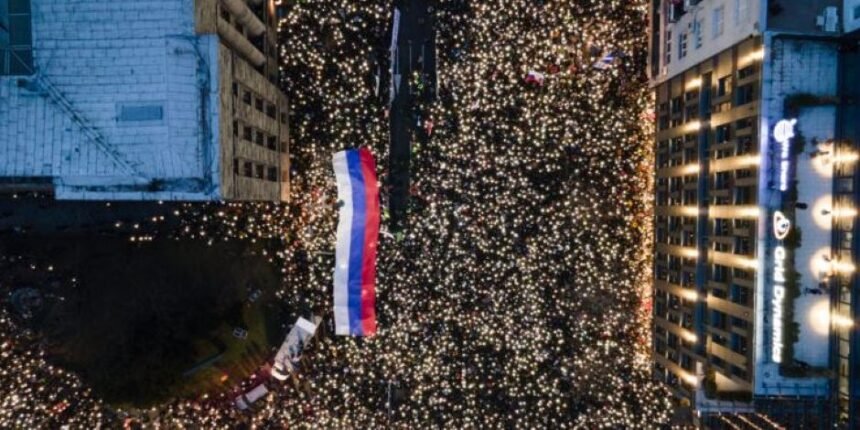
Serbia has endured more than a year of continuous protests, blockades, sit-ins, and demonstrations against President Aleksandar Vucic’s government, sparked by the Novi Sad railway station collapse in November 2024, which killed 16 people. What began as grief quickly turned into persistent anger, but despite massive public participation, no meaningful political change has occurred.
Estimates of protest attendance range from 100,000 to over 300,000, making them the largest demonstrations Vucic has faced. The opposition remains fragmented and without a coherent political platform, while the government uses aggressive tactics to maintain control, including plainclothes provocateurs, criminal elements, and even military-grade sonic weapons, according to credible reports.
The protests, initially peaceful and urban-centered, have spread to provincial towns and are increasingly fueled by economic frustration, migration, and ecological concerns. Serbia’s recent mass immigration of foreign workers—driven by labor shortages and low wages—has intensified nationalist sentiment among some protest factions.
Despite the momentum, the movement faces structural challenges:
- No unifying leadership or viable political candidates
- Limited ability to reach rural and working-class voters, who largely support Vucic
- High odds that upcoming parliamentary elections will favor the government, given media dominance and entrenched patronage networks
Analysts warn that Serbia could be approaching a tipping point. The movement’s lack of formal political leverage, combined with the government’s increasingly confrontational tactics, raises the risk of violent escalation reminiscent of Ukraine’s Euromaidan (2013–2014)—hence the term “Serbo-Maidan”.
Experts caution that while violence is not inevitable, the combination of prolonged public outrage, political stalemate, and structural repression makes it increasingly plausible, particularly if the government fails to allow meaningful channels for dissent or if opposition forces cannot present a viable alternative.
Looking ahead, the 2027 presidential elections, when Vucic reaches his term limit, may present the next critical juncture. Without a clear successor, Serbia could face political upheaval similar to the Putin-Demedev power rotation in Russia, heightening the potential for instability.
Key takeaway: Serbia’s protests continue with a mix of peaceful activism and intermittent confrontations, but structural weaknesses in the opposition and aggressive government tactics mean that the situation could escalate into a more violent and transformative phase, depending on how both sides act in the lead-up to future elections.