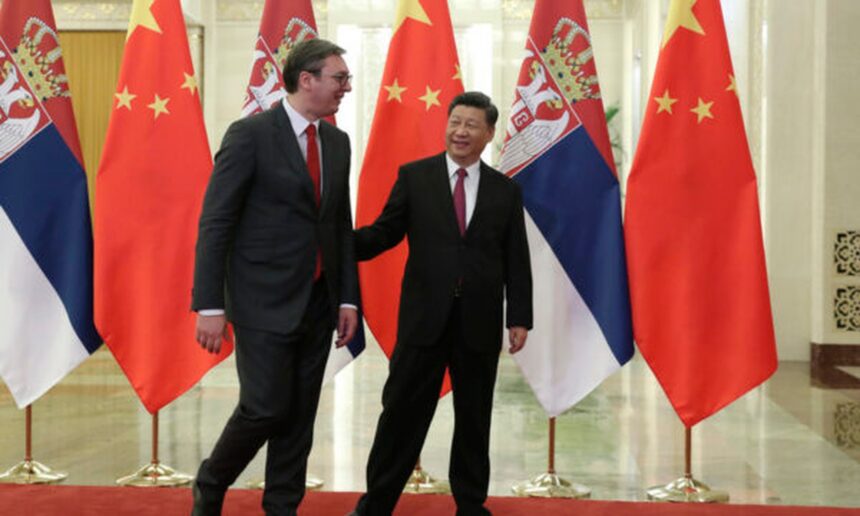
Around 11% of Serbia’s external debt consists of liabilities to China’s state-owned Export-Import Bank (EXIM), according to the latest October report by the Public Debt Administration, operating under Serbia’s Ministry of Finance.
Serbia is currently repaying more than 10 Chinese loans, mostly taken for infrastructure projects, with a total value of approximately €2.8 billion.
However, Serbia’s real debt to China is even higher, as the country has also borrowed from the Bank of China, particularly for municipal infrastructure and sewage projects, as outlined in Serbia’s 2026 state budget.
The National Bank of Serbia has refused to disclose data on total debt to Chinese banks and the Chinese state, citing confidentiality, while the Ministry of Finance did not respond to inquiries from Radio Free Europe (RFE/RL).
Official data show that Serbia is more exposed to loans from China’s EXIM Bank than to several European financial institutions, including the European Investment Bank (EIB).
Political scientist and researcher on Chinese investments, Sonja Stojadinović, says this preference is expected, as Chinese procedures are faster but far less transparent.
“Chinese loans are obtained more quickly and with fewer political conditions, but they lack transparency and public tender procedures,” she said.
The involvement of Chinese companies in Serbia’s infrastructure projects has often been accompanied by accusations of bypassing public tenders. Serbian authorities rely on a 2009 economic and technical cooperation agreement with China, which allows for direct contracting.
Concerns over transparency intensified following the November 2024 tragedy at the Novi Sad railway station, where 16 people lost their lives. The project was carried out by a Chinese consortium without a public tender and is currently under investigation by Serbia’s Organized Crime Prosecutor’s Office.
Serbia will repay the loan for this project until 2039, with the current debt standing at €763 million.
According to Stojadinović, Serbian authorities favor Chinese loans because they do not come with political conditions—unlike European loans, which require standards related to elections, human rights, and media freedom.
Although Chinese loans are on average 0.5 to 1.2 percentage points more expensive, they are seen as a fast way to complete infrastructure projects ahead of elections.
China views Serbia as part of its strategic “Belt and Road Initiative”, aiming to link Greece’s Port of Piraeus with Central Europe through railways and highways.
Beyond loans, China is also present in Serbia through major investments in mining, metallurgy, and energy, often criticized for environmental pollution and lack of accountability.
Experts warn that Serbia–China cooperation contains many “grey zones”, particularly due to secret contracts, lack of public tenders, and suspicions of corruption.