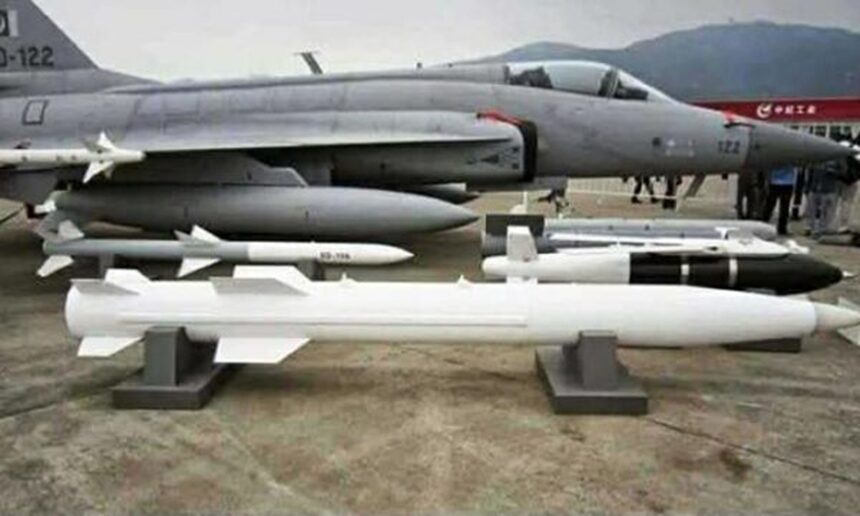
Serbian President Aleksandar Vučić confirmed on March 12 that Serbia has purchased CM-400 supersonic ballistic missiles from China.
“We have a significant number of missiles and will acquire even more,” Vučić said in an interview with Radio Television of Serbia.
He added that the Serbian Armed Forces have already successfully integrated the Chinese missiles into their Russian MiG-29 fighter jets.
His statement follows the recent release of photographs by a specialized military forum showing several Serbian Air Force jets. One of the aircraft, it was claimed, was armed with a long-range Chinese air-to-surface missile marked CM-400, while another carried a Chinese-manufactured LS-6 aerial bomb.
Vučić noted that the jets armed with Chinese missiles were “filmed by chance.”
He declined to answer questions regarding the cost of the missiles. “The missiles are extremely expensive. We got them with a small discount,” he said, adding that their range is between 200 and 400 kilometers and that they possess high destructive power.
Croatian Prime Minister Andrej Plenković responded to the purchase, stating that his country—a member of the European Union and NATO—will consult with its allies regarding the matter.
“We will speak with our partners in NATO and inform them about these weapons, which are new to the Serbian military arsenal,” Plenković said. However, he added that he does not expect such a powerful weapon to ever be used against neighboring countries, including Croatia.
Despite warnings from Brussels and Washington, Serbia continues to expand its military cooperation with China. According to data from the Stockholm International Peace Research Institute (SIPRI), between 2020 and 2024, Serbia imported the majority of its weapons from China (57%), followed by Russia (20%) and France (7.4%).
Responding to Plenković’s statement, Vučić said, “Zagreb will not decide what Serbia has.” He also noted that Serbia is “preparing for the possibility of an attack from the alliance forming between Pristina, Tirana, and Zagreb.”
During a visit to India in mid-February, Plenković assured him that military cooperation between Croatia, Albania, and Kosovo is not directed against Serbia.
“I heard that, and that’s it. But do I still have a dose of concern and fear? Yes, I do,” Vučić admitted.
In March 2025, Croatia, Albania, and Kosovo signed a Declaration on Cooperation in Defense and Security, which Serbian officials described as a threat to Serbia’s security.