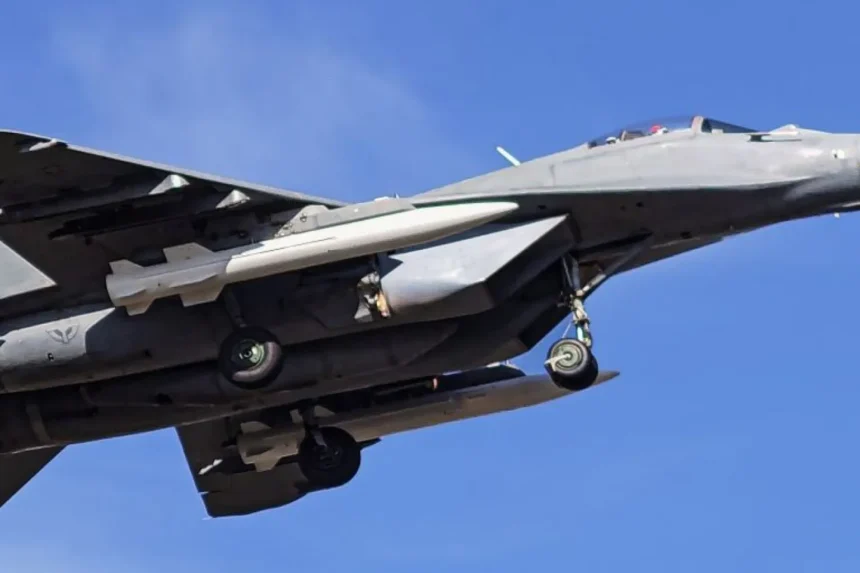
In a surprising development, Serbia has emerged as an operator of the Chinese-made CM-400 air-launched supersonic missile, a weapon previously only known in Pakistani service. The missile has now been integrated into Serbia’s upgraded Soviet-era MiG-29 Fulcrums, giving the Balkan state a missile capability uncommon in Europe outside Russia. A recent photograph shows a Serbian Air Force MiG-29 carrying a pair of CM-400 missiles on its inboard underwing hardpoints.
Previous Clues and Statements
Belgrade-based defense journalist Petar Vojinović noted that Gen. Milan Mojsilović, chief of the General Staff of the Serbian Armed Forces, stated last month: “In the air component, we have weapons of a similar maximum range and lethality [to the PULS rocket artillery system].” Serbian President Aleksandar Vučić also alluded to new military capabilities, saying: “…people couldn’t dream about everything we have, everything we are acquiring, they couldn’t dream.”
CM-400 Specifications
The CM-400, developed by China Aerospace Science and Industry Corporation (CASIC), is primarily an export weapon. Unveiled in 2012, it is supersonic, capable of speeds up to Mach 4.5, and carries either a 330-pound high-explosive warhead or a 440-pound armor-piercing warhead. Its reported range varies between 155 and 250 miles, and it is optimized for anti-ship, anti-radiation, and ground target strikes. The missile’s guidance includes inertial navigation with GNSS correction, and for terminal attack relies on infrared, optoelectronic, or passive radar seekers, achieving a CEP as low as 16 feet for anti-ship targets.
Integration on MiG-29s
In Serbian service, the CM-400 is carried by the MiG-29SM+ fleet, which consists of 14 aircraft. Integration is achieved using CATIC’s Standalone Weapon Fire Control System (SWFCS), enabling non-Chinese aircraft to operate Chinese missiles without extensive modifications. The system uses a tablet interface in the cockpit, allowing pilots to launch missiles with precision and speed.
Strategic Impact
The missile provides Serbia with a high-speed, long-range standoff strike capability, capable of attacking hardened strategic targets, mobile air defenses, and time-sensitive objectives. This represents a significant enhancement of Serbia’s air power, especially given its otherwise modest air force. The acquisition signals a diversification of military suppliers, with Serbia now purchasing weapons from China, Israel, and Airbus, alongside adopting NATO-style doctrine and participating in joint exercises with the U.S. Air Force.
Regional and Global Implications
With the CM-400, Serbia has secured a capability likely unique in the region, combining speed, range, and precision. The missile’s adaptability on non-Chinese platforms suggests that other nations may also adopt it to enhance their air-launched precision strike capabilities. While Serbia has traditionally relied on Russia, Western sanctions have forced diversification, and the CM-400 integration highlights Belgrade’s efforts to modernize and expand its military reach.