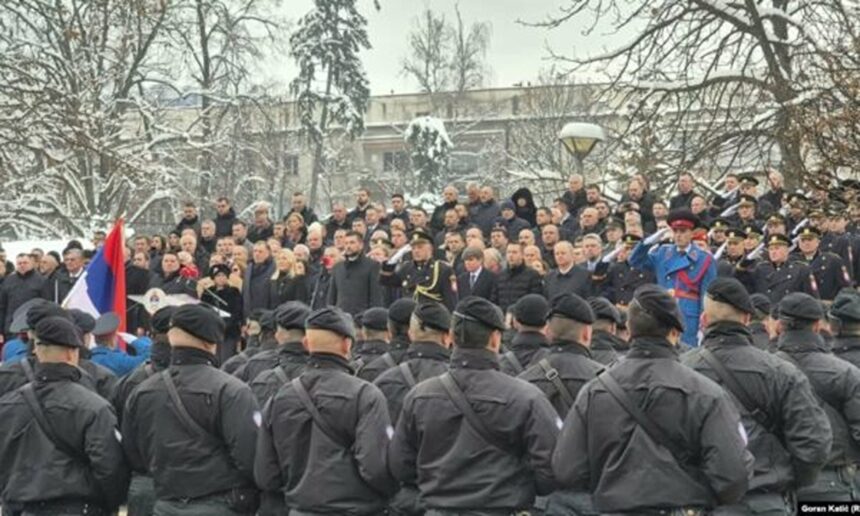
Republika Srpska, the Serb entity of Bosnia and Herzegovina, marked January 9, its so-called “Day of Republika Srpska,” on Friday with a parade in the streets of Banja Luka—a date that the Constitutional Court of Bosnia and Herzegovina has ruled unconstitutional and discriminatory against Bosniaks and Croats on three separate occasions.
Under amendments to Bosnia and Herzegovina’s Criminal Code introduced in 2023 by the High Representative Christian Schmidt, penalties are предусмотрed for non-compliance with Constitutional Court rulings. Anyone involved in organizing the unconstitutional celebration of January 9 may face six months to five years in prison, as well as bans on holding public office. Despite this, no one has been sanctioned so far.
The Prosecutor’s Office of Bosnia and Herzegovina told Radio Free Europe/Radio Liberty that a case was opened a year ago regarding the previous marking of Republika Srpska Day, and that two prosecutors are currently working on the case.
Who attended the parade?
The parade in Krajina Square in Banja Luka—secured by around 800 police officers—was attended by officials from Serbia, alongside leaders of Republika Srpska.
Approximately 2,000 participants from around 30 civil society organizations from Republika Srpska and neighboring Serbia also took part.
Among the guests observing the parade were Željka Cvijanović, a member of Bosnia and Herzegovina’s Presidency; Savo Minić, Prime Minister of Republika Srpska, along with ministers; Ana Trivić-Babić, acting President of Republika Srpska; Nenad Stevandić, President of the entity’s National Assembly; and other entity and state representatives.
Former Republika Srpska President Milorad Dodik was present, as was Rod Blagojevich, former Governor of Illinois. Unlike previous years, Russia’s ambassador to Bosnia and Herzegovina, Igor Kalabukhov, did not attend.
Participants also included members of a branch of the Russian motorcycle group “Night Wolves,” known for its support of the Kremlin. In addition to officers of the Ministry of Interior (MUP)—including the Special Anti-Terrorist Unit and police academies—members of various veterans’ organizations marched as well.
ANSAT helicopters purchased from Russia by the Republika Srpska Aviation Administration were displayed, along with “Despot” and “Vihor” armored vehicles.
Earlier, a religious liturgy was held at the Cathedral of Christ the Savior, led by Serbian Patriarch Porfirije. Several ministers and MPs from Serbia attended, led by Serbia’s Minister of Culture Nikola Selaković.
Serbian President Aleksandar Vučić sent a congratulatory message marking what he called “34 years of existence and the struggle to preserve the Serbian name, faith, tradition, customs, and identity.” Serbia’s Interior Minister Ivica Dačić stated, among other things, that “January 9 is one of the most important dates for the Serbian people.”
Why is this day controversial?
Authorities in Republika Srpska celebrate January 9 as the date when, in 1992, the then Assembly of the Serb people of Bosnia adopted a declaration proclaiming the Serb Republic of Bosnia as a separate entity within Bosnia and Herzegovina.
However, the Constitutional Court of Bosnia and Herzegovina has ruled three times that celebrating January 9 as Republika Srpska Day is unconstitutional.
At the time, the aim was for this territory to join Yugoslavia, which was in the process of disintegration. Leaders of the self-proclaimed republic included Radovan Karadžić, Biljana Plavšić, and Momčilo Krajišnik, all of whom were convicted of war crimes by the Hague Tribunal.
Representatives of Bosniaks and Croats did not participate in the adoption of the declaration. These two communities view January 9 as the beginning of the war in Bosnia and Herzegovina, as well as the start of ethnic cleansing, war crimes, and genocide against the non-Serb population in the territory of Republika Srpska. /RFE/RL/