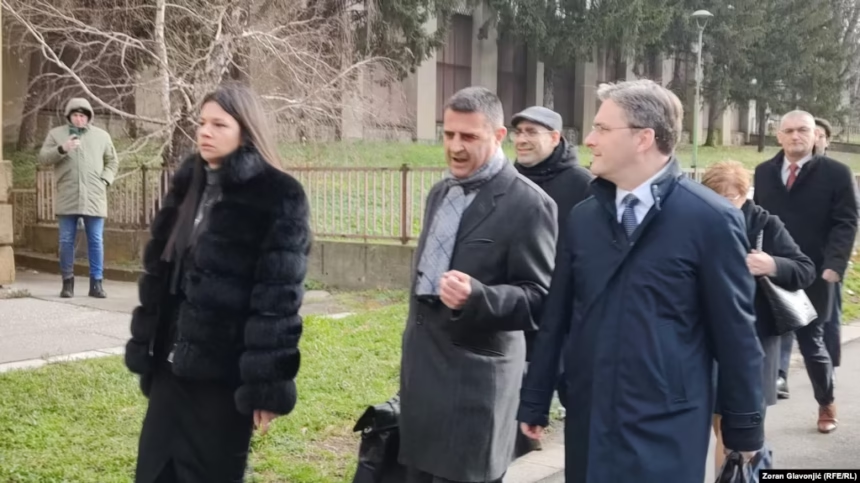
Serbian Minister of Culture Nikola Selaković has denied charges of abuse of office and document falsification at the opening of his trial before the Special Court in Belgrade, in a case linked to the controversial removal of cultural heritage protection from the former General Staff complex.
During the hearing, Selaković stated that he understood the indictment linguistically and grammatically but claimed he did not understand what criminal act he had allegedly committed. He also refused to invoke ministerial immunity, although such protection is permitted under Serbia’s Constitution. The presiding judge confirmed that the court would still formally notify the Serbian government, which retains the authority to request immunity on his behalf.
Allegations of Falsifying Documents
Selaković, along with three other officials from state institutions, is accused of facilitating the loss of protected cultural heritage status for the General Staff complex, which was heavily damaged during NATO airstrikes in 1999. Prosecutors allege that falsified documentation was used to justify stripping the complex of legal protection, thereby enabling plans for redevelopment.
According to the indictment, Selaković allegedly exceeded his official authority and caused damage to Serbia’s cultural heritage by endorsing documents containing false information. Prosecutors are seeking a three-year prison sentence.
The case also involves Slavica Jelača, acting secretary at the Ministry of Culture; Goran Vasić, acting director of the Republic Institute for the Protection of Cultural Monuments; and Aleksandar Ivanović, director of the Belgrade Institute for Cultural Monument Protection. Reports indicate that Vasić has admitted to falsifying documents, allegedly following instructions connected to the ministry.
Controversial Redevelopment Project
Removing the protected status was viewed as a crucial step toward allowing construction of a luxury residential and business complex in central Belgrade. The project was planned by Affinity Partners, a private company owned by Jared Kushner, the son-in-law of former U.S. President Donald Trump.
However, Kushner’s firm withdrew from the project on December 15, 2025, the same day the indictment against Selaković was filed. The company stated that the decision was made “out of respect for the citizens of Serbia and Belgrade,” without providing further explanation.
Public Protests and Political Fallout
The trial has intensified public and political divisions, with students, opposition parties, and cultural experts opposing the demolition and advocating for preservation and restoration of the historically significant complex.
Demonstrators gathered outside the courthouse, chanting anti-government slogans and briefly blocking nearby streets. Protest organizers stated that their presence was meant to monitor the judicial process rather than influence the court’s decision.
Meanwhile, Serbian authorities, including President Aleksandar Vučić, have supported redevelopment plans, arguing that the damaged structures are beyond restoration and that redevelopment could boost economic growth. Parliamentary Speaker Ana Brnabić criticized the trial, describing it as “pointless and shameful” and framing it as an attack on state interests.
Accusations of Political Pressure
Selaković and government officials have repeatedly claimed that the prosecution is politically motivated, alleging without evidence that prosecutors are acting on behalf of unspecified external power centers. Prosecutors, however, have warned that such statements represent pressure on judicial institutions and could threaten prosecutorial independence and safety.
Legislative Moves and Ongoing Dispute
Despite ongoing legal proceedings, Serbian authorities passed a special law in late 2025 removing the General Staff complex from the register of protected cultural heritage sites. The government justified the move by citing severe structural damage and high restoration costs, while critics argue that the decision undermines cultural preservation standards and transparency in state-led redevelopment projects.
The investigation into the case was initially launched in May 2025, and legal proceedings are expected to continue amid strong public scrutiny and political controversy.