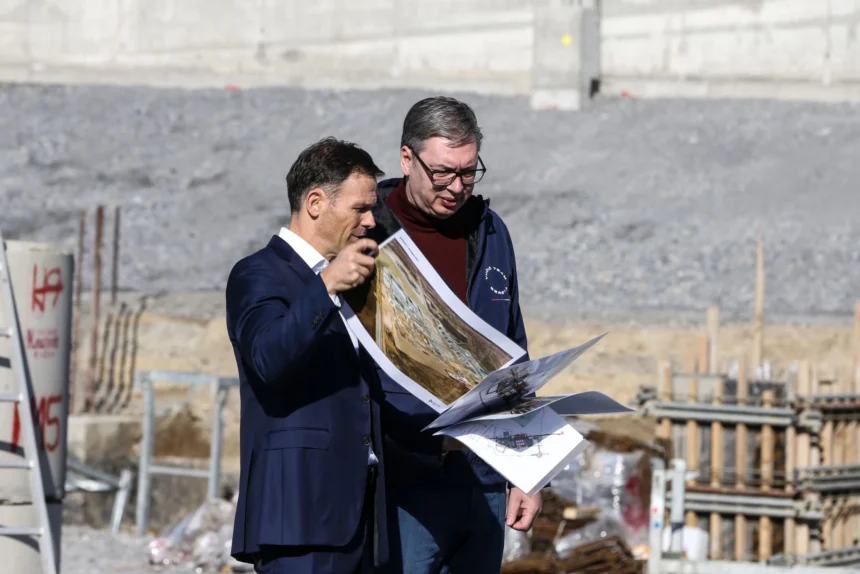
Serbia’s economic growth statistics, repeatedly cited by President Aleksandar Vučić and Finance Minister Siniša Mali, are under scrutiny as experts warn that official figures overstate progress and obscure the country’s deep structural vulnerabilities.
Nominal GDP Misleadingly Inflated
At the BELTALKS Forum, Minister Siniša Mali claimed that Serbia’s GDP per capita doubled from €4,800 in 2012 to €15,800 in 2025, presenting the country as a regional economic powerhouse.
However, economists emphasize that Mali relied on nominal GDP, which includes inflation effects. Nominal growth does not reflect real economic expansion, as prices rising can artificially inflate GDP without increasing actual production.
According to Eurostat data, Serbia’s real GDP per capita increased only 49.6% from 2012 to 2024, placing it ninth in Europe, far behind Mali’s claimed fourth place. Countries outpacing Serbia include Ireland (100.7%), Malta (61.2%), Lithuania (53.5%), and Poland (51.9%), highlighting the stark contrast between political narratives and economic reality.
Slow Convergence with the EU
Despite government rhetoric, Serbia’s GDP per capita in 2024 stood at €8,900, a quarter of the EU average (€33,650). At the current growth rate of 3.3% per year, Serbia would reach EU average levels only by 2092, illustrating the limitations of the so-called “catch-up effect” touted by Vučić’s administration.
Foreign Direct Investment (FDI) Overstated
Mali also claimed that Serbia attracted over 60% of regional FDI, totaling €5.2 billion. Experts point out that:
- The actual average was 53% of FDI in the Western Balkans (2012–2024)
- The first nine months of 2025 saw a 34% drop in gross FDI and a 56% drop net, signaling growing economic dependence on foreign capital
- Serbia’s FDI relative to GDP is 5.9%, behind Montenegro (10.6%) and Albania (7.8%), exposing structural weaknesses in domestic investment and economic sovereignty
Structural Vulnerabilities Ignored
- Government projections of 3% GDP growth in 2026 fail to account for:
- Challenges in the NIS oil and gas sector
- Potential energy supply disruptions
- Continued decline in FDI inflows
- Fiscal pressures from international market volatility
Experts argue that without rapid structural reforms, Serbia’s economic growth remains fragile, dependent on political spin and external capital rather than real productivity increases.
Conclusion: Reality vs. Political Narratives
The contrast between government claims and real economic indicators paints a worrying picture:
- Serbia is lagging behind regional peers in real GDP growth
- Economic growth is highly dependent on foreign investment, exposing the country to external shocks
- Misrepresentation of statistics serves political interests of Vučić’s government rather than informing citizens about genuine economic challenges
For meaningful progress, Serbia must focus on real GDP growth, domestic investment, and energy security, rather than continuing to rely on inflated numbers and political narratives.