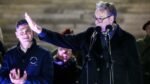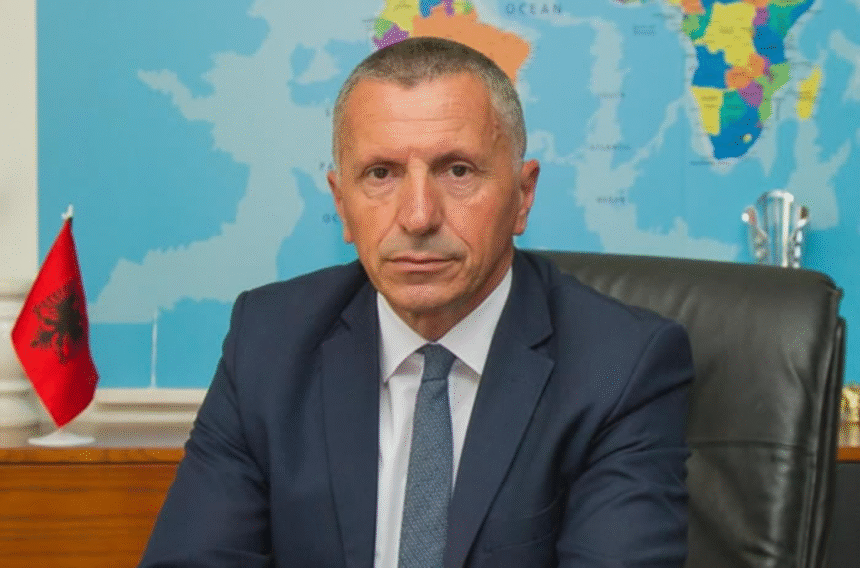
Serbia is facing a deep political crisis, while President Aleksandar Vučić is surviving in power “on artificial life support,” says Shaip Kamberi, the only Albanian MP in the Serbian Parliament and leader of the Party for Democratic Action (PDA), in an interview with KosovaPress.
Kamberi predicts that 2026 will be an election year in Serbia and warns that these elections could mark the end of Vučić’s rule. He also calls for stronger and more concrete support from Prishtina and Tirana, urging that the Presheva Valley be declared a matter of national importance for Kosovo.
“Vučić’s Power Is Delegitimized”
According to Kamberi, Vučić has remained in power despite a year of protests, but his authority is increasingly delegitimized, both domestically and internationally.
“Vučić is not governing; he is merely surviving. Serbia is experiencing one of its deepest political crises since the assassination of Prime Minister Zoran Đinđić in 2003,” Kamberi said.
He argues that Vučić’s foreign policy of ‘balancing’ between China, Russia, Washington, and Brussels has collapsed, citing:
- The EU’s harshest criticism yet in Serbia’s 2025 Progress Report
- New U.S. legislation signed by President Donald Trump, highlighting democratic backsliding
- Serbia being explicitly named as the only Western Balkan country with democratic regression
Elections in 2026: A Turning Point
Kamberi believes early elections in 2026 are highly likely, warning that:
- If Vučić loses, it will end his rule
- If Vučić wins through manipulation, the results will not be recognized by the opposition, students, or civil society
“Either way, Serbia is heading toward an even deeper crisis, with no stability and no real prospects for EU integration,” he said.
Discrimination Against Albanians in the Presheva Valley
Kamberi highlights systematic state discrimination against Albanians in Presheva, Bujanoc, and Medveđa, warning of institutional exclusion and demographic pressure.
- No recruitment of Albanian police officers since 2016
- Risk that within a decade there will be no Albanian police officers at all
- Comparison with Kosovo’s higher minority-rights standards, which he says Serbia refuses to apply domestically
“With the current trend, we are heading back to the situation of 1999–2000, when there were virtually no Albanian police officers,” he warned.
Medveđa: “A Silent Ethnic Cleansing”
Kamberi says the most severe discrimination is occurring in Medveđa, where:
- Address deactivation
- Non-recognition of diplomas
- Administrative pressure
have led to what he describes as a de facto ethnic cleansing, a process documented by:
- Serbian civil society
- International organizations
- European Parliament resolutions
“Serbia’s Parliament Is a Toxic Environment”
Kamberi describes the Serbian Parliament as “toxic”, dominated by Vučić’s party and satellite allies, including SPS and minority parties aligned with the government.
“Important initiatives for minority rights and EU integration are systematically ignored,” he said.
Call to Kosovo and Albania
Kamberi urges:
- Political unity among Albanian parties in the Presheva Valley
- Official coordination and concrete support from Prishtina and Tirana
- The next Kosovo government and parliament to declare the Presheva Valley a national issue
“This must be among Kosovo’s top priorities—not seventh or eighth on the list,” Kamberi emphasized.
Protests and Demographics
In 2024, three mass protests were held in Presheva, Bujanoc, and Medveđa under the slogan “Return My Address”, protesting discriminatory policies.
According to the 2022 census, more than 60,000 Albanians live in Serbia.