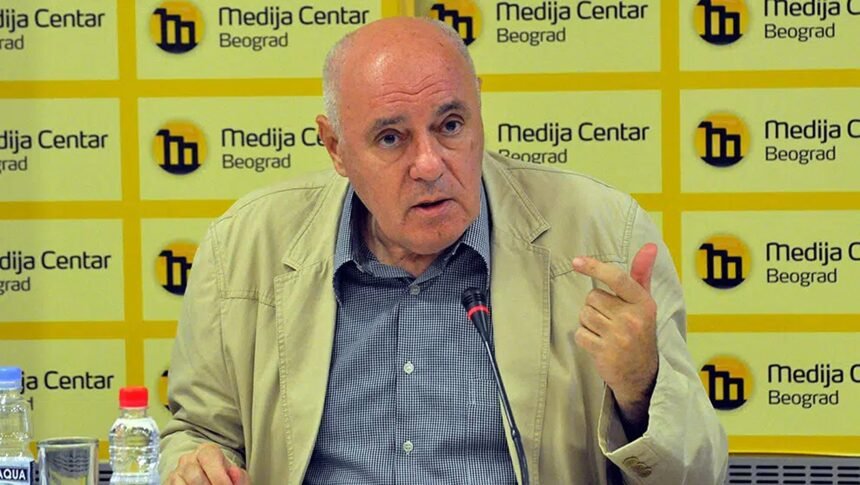
Zagreb, Croatia – Croatian professor and political analyst Žarko Puhovski has sharply criticized both the Serbian government and opposition, warning that Serbia’s political landscape remains dangerously opaque and misaligned with European Union values.
Speaking to HRT’s “Studio 4,” Puhovski said that while the commemorative meeting in Novi Sad remained peaceful, the calm was more a reflection of convenience than true democratic progress. “If any side wanted to be restless, it would have been restless. It suited everyone to be calm, and that’s an anticlimax,” he explained.
The analyst highlighted a worrying trend within the opposition, noting that while they are against President Aleksandar Vučić, many are ideologically further from the EU and closer to Russia than the current government. “We don’t know who these people are. How am I going to believe in the democratic transition of such a secretive group that is obviously well organized but has no program?” Puhovski warned.
At the same time, he criticized Vučić’s government for passivity and over-reliance on international actors. “The impression is that the government and the opposition in Serbia are waiting to see what decision America, specifically President Donald Trump, will make,” he said. Puhovski described a “Bismarckian” attitude in which foreign leaders allow internal factions to fight while negotiating with the eventual winner—a scenario that leaves Vučić potentially vulnerable while the opposition’s true agenda remains unclear.
Puhovski also singled out the media environment as a critical problem, describing it as skewed heavily in favor of the government. “There are three media that are not propaganda of the regime machinery. This is far worse than in Tudjman’s time. One party has control over the media, and that’s a real problem,” he emphasized.
In sum, Puhovski placed responsibility squarely on both sides: the opposition for its secrecy, lack of program, and questionable allegiances, and Vučić for consolidating media power and waiting passively for foreign signals. “Everyone is talking about the students, but who are they? What do they stand for? Nobody knows. It is terribly dangerous,” he concluded.
The analyst’s remarks underscore the fragile state of democracy in Serbia, where neither the government nor the opposition appears fully committed to transparent governance or alignment with European democratic standards.